
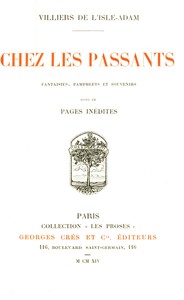
Chez les passants: fantaisies, pamphlets et souvenirs. Suivi de pages inédites
Let's clear something up first: this isn't a novel. 'Chez les passants' is a mixed bag, and that's its charm. It's a collection of short pieces—stories, essays, satires, and personal reflections—published together. The 'pages inédites' in the title are unpublished writings added later, giving us an even deeper look into the author's mind.
The Story
There's no single plot. Instead, Villiers de L'Isle-Adam acts as your guide through the streets and salons of 19th-century Paris. One moment, he's crafting a dark, symbolic fantasy about a man who builds a perfect mechanical woman. The next, he's launching a funny but brutal attack on the trendy ideas and bad taste of his time. Then he might shift to a quiet, personal memory that feels like a faded photograph. The thread connecting it all is his perspective: that of an outsider looking in, both fascinated and frustrated by the 'passersby' in life's great spectacle.
Why You Should Read It
I love this book because Villiers feels like a friend from the past who gets it. His humor is dry and timeless. When he mocks pretentious artists or pompous officials, it still lands today. But he's not just a critic. His fantastical stories, like the famous 'The Future Eve,' show a desperate, beautiful longing for something more perfect than reality. Reading him is like having a conversation with a brilliant, moody genius over a cup of coffee. You get the jokes, you feel the dreams, and you see the world through a slightly more poetic, slightly more irritated lens.
Final Verdict
This is perfect for readers who want to explore classic French literature but find some of it too heavy or formal. It's for anyone who enjoys short, powerful pieces they can dip in and out of. If you like the sharp wit of Oscar Wilde, the imaginative gloom of Edgar Allan Poe, or even the observational humor of modern essayists, you'll find a kindred spirit here. Just don't expect a straightforward story—expect a fascinating, fragmented portrait of a mind and an era.
This is a copyright-free edition. Access is open to everyone around the world.
Mason Anderson
9 months agoFrom the very first page, the author's voice is distinct and makes complex topics easy to digest. I would gladly recommend this title.
Christopher Torres
1 year agoIf you enjoy this genre, the storytelling feels authentic and emotionally grounded. Exceeded all my expectations.
Oliver Johnson
1 year agoVery interesting perspective.
Linda Johnson
1 year agoI had low expectations initially, however the content flows smoothly from one chapter to the next. I couldn't put it down.
Emily Davis
4 months agoHaving read the author's previous works, the insights into future trends are particularly thought-provoking. I am looking forward to the author's next publication.