
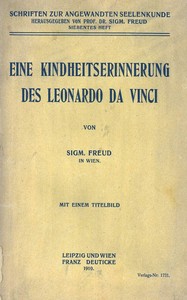
Eine Kindheitserinnerung des Leonardo da Vinci by Sigmund Freud
This isn't your typical biography. Freud isn't interested in listing Leonardo's paintings or inventions. Instead, he picks up one tiny thread: a memory Leonardo himself wrote down about a bird (a 'nibio' or kite) landing on his cradle as a baby and pushing its tail into his mouth. From this single, almost dream-like fragment, Freud spins a whole world.
The Story
Freud uses this childhood memory as a key. He argues that Leonardo's intense curiosity, his artistic drive, and even his famous procrastination can be traced back to his early years. A big part of his theory focuses on Leonardo being raised by his biological mother and then, later, by his father and stepmother. Freud suggests this shaped his relationships and his art. The most famous example is the Mona Lisa's smile, which Freud sees as a reflection of Leonardo's own mother's smile, forever captured on canvas. The book is Freud's attempt to show how the man who painted the most famous portrait in the world and designed flying machines was, in many ways, still exploring the echoes of his childhood.
Why You Should Read It
You read this book for the audacity of it. It's thrilling to watch Freud connect dots across centuries, turning a sketchbook note into a deep psychological profile. It makes you look at Leonardo's work in a completely new light. Is Freud right? Historians have since questioned his facts (like the mistranslation of 'nibio' as a vulture). But that's almost beside the point. The value is in witnessing the birth of psychoanalytic thinking applied to a historical figure. You see Freud's brilliance, his leaps of logic, and his unwavering belief that our earliest experiences shape everything. It's a short, powerful example of one genius trying to dissect another.
Final Verdict
This book is perfect for curious minds who love art history, psychology, or just a great intellectual detective story. It's not for readers who want a straightforward, fact-checked biography. It's for those who enjoy a bold, controversial argument that makes you think. If you've ever stared at the Mona Lisa and wondered about the person who painted her, Freud offers one of the most fascinating and personal explanations you'll ever find. Just be ready to question his conclusions as much as you admire his attempt.
This title is part of the public domain archive. Use this text in your own projects freely.
Jennifer Anderson
2 years agoThe citations provided are a goldmine for further academic study.
Margaret Moore
1 year agoI've been looking for a reliable source on this topic, and the chapter on advanced strategies offers insights I haven't seen elsewhere. I’ll definitely be revisiting some of these chapters again soon.
Michael Garcia
8 months agoAs a long-time follower of this subject matter, the author doesn't just scratch the surface but goes into meaningful detail. The insights gained here are worth every minute of reading.
Paul Jackson
1 month agoThis digital copy caught my eye due to its reputation, it addresses the common misconceptions in a very professional manner. This has become my go-to guide for this specific topic.





George Hernandez
7 months agoThe author provides a very nuanced critique of current methodologies.