
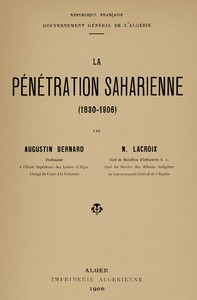
La pénétration saharienne (1830-1906) by Augustin Bernard and Napoléon Lacroix
Let's be clear: this isn't a novel. You won't find a single protagonist to follow. Instead, La pénétration saharienne is a detailed chronicle of a seventy-six-year process. It tracks the incremental, often halting, advance of French influence from the coastal regions of Algeria deep into the heart of the Sahara.
The Story
The book starts in 1830 with the French capture of Algiers and follows the decades-long effort to secure the territory behind it. The 'plot' is the relentless push south. It's a story of military columns facing scorching heat and ambushes, of treaties signed and broken with powerful tribal confederations, and of rival explorers and soldiers racing to claim oases and trade routes. The desert isn't just a setting; it's a central character—a formidable barrier that dictated the pace and shape of everything. The narrative builds through a series of campaigns, diplomatic missions, and the establishment of remote outposts, culminating in the formal organization of the French Saharan territories by 1906.
Why You Should Read It
What grabbed me was the sheer logistical nightmare of it all. This book strips away any myth of colonial inevitability. Every mile gained was a hard-fought struggle against a hostile environment and determined resistance. Bernard and Lacroix write with the authority of insiders, which gives their account a chilling matter-of-factness. They detail troop movements, water supply issues, and political calculations with precision. You get a clear, unsentimental picture of how imperial power was actually projected onto a map, piece by difficult piece. It’s history written not from a grand palace, but from a dusty tent on the frontier.
Final Verdict
This is a specialist's book, but its appeal is broader. It's perfect for history buffs who are tired of broad overviews and want to see the gears of empire turning up close. Readers interested in North African history, military history, or the geography of power will find it invaluable. A fair warning: it assumes some basic knowledge of the period and region. It's not a light read, but for the right reader, it’s a compelling and authoritative window into a pivotal, complex era that still echoes today.
This work has been identified as being free of known copyright restrictions. It serves as a testament to our shared literary heritage.
Emily Williams
2 years agoFinally found a version that is easy on the eyes.
John Moore
1 year agoA brilliant read that I finished in one sitting.
David Rodriguez
3 months agoIt’s refreshing to see such a high standard of digital publishing.
Robert Martinez
9 months agoThe layout is perfect for tablet and e-reader devices.




James Jones
7 months agoLooking at the bibliography alone, it manages to maintain a consistent flow even when discussing difficult topics. The price-to-value ratio here is simply unbeatable.