
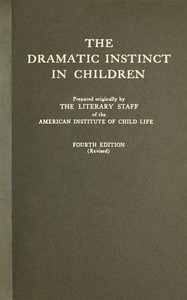
The dramatic instinct in children by American Institute of Child Life
Don't expect a novel with a plot. Instead, think of this as a guided tour through a child's imagination. Published in 1916 by the American Institute of Child Life, this book is a collection of observations and ideas about why children play make-believe. It breaks down the 'dramatic instinct' into different parts, showing how it pops up in everything from a toddler mimicking their parent to a group of kids acting out a complex adventure story. It talks about how this instinct helps with emotional growth, social skills, and intellectual development. The author (who remains unknown) uses clear examples that still feel familiar today, arguing that this drive to perform is a positive and necessary part of growing up.
Why You Should Read It
This book is a quiet revelation. Reading it feels like someone finally putting a name to something you've always felt was true. It validates the messy, loud, and sometimes chaotic world of children's play as something profoundly important. What struck me most was its timelessness. Even though it was written in a different era, the core idea—that pretending is practice for life—feels incredibly modern. It made me rethink my own childhood games and see my niece's elaborate tea parties in a whole new light. It's not a dry academic text; it's written with a clear respect for children and their inner world. You finish it feeling like you've been given a secret decoder ring for understanding kid behavior.
Final Verdict
This is a perfect little book for curious parents, teachers, grandparents, or anyone who spends time with kids and wants to understand them better. It's also a great pick for history lovers interested in early 20th-century views on childhood and education. If you're looking for a fast-paced story, this isn't it. But if you want a thoughtful, insightful essay that will change the way you watch children play, give this a couple of hours of your time. It's a reminder that sometimes, the most important work a child does looks a lot like fun.
This work has been identified as being free of known copyright restrictions. You do not need permission to reproduce this work.
Mary Lopez
2 months agoFrom a researcher's perspective, the narrative arc keeps the reader engaged while delivering factual content. An excellent example of how quality digital books should be formatted.
Elizabeth Perez
3 weeks agoI appreciate how this edition approaches the core problem, the bibliography and references suggest a high level of research and authority. I'm glad I chose this over the other alternatives.
Kimberly Rodriguez
5 months agoI appreciate how this edition approaches the core problem, the emphasis on ethics and sustainability within the topic is commendable. Finally, a source that prioritizes accuracy over hype.

George Hernandez
1 month agoAs a professional in this niche, the author manages to bridge the gap between theory and practice effectively. A refreshing and intellectually stimulating read.