
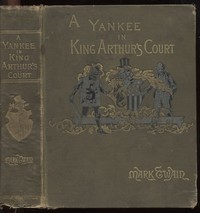
A Connecticut Yankee in King Arthur's Court, Part 4. by Mark Twain
If you thought Hank Morgan had it all figured out, Part 4 of A Connecticut Yankee is where Twain pulls the rug out from under him—and us. The sheer audacity of this book is that it’s a comedy with a very sharp, very dark edge.
The Story
Hank, now known as "The Boss," has been busy. He’s industrialized Camelot with telegraph lines and secret factories. He’s trying to educate the masses and undermine the nobility’s power, all while keeping up the charade of being a powerful magician. But in this section, the resistance solidifies. The established church, feeling threatened by his modern ideas, starts to move against him. You see Hank constantly putting out fires, both literal and political. He’s managing a kingdom-wide operation with 19th-century know-how, but the 6th-century mindset of the people is his biggest obstacle. The plot becomes a tense balancing act between his grand reforms and the daily reality of superstition and feudal loyalty.
Why You Should Read It
This is where the book stops being just a silly fish-out-of-water tale and becomes something much smarter. Twain uses Hank’s frustration to ask real questions: Can you force people to be free? Is technological progress the same as social progress? Hank is so convinced of his own rightness that he becomes a bit of a tyrant himself, which is a brilliant, ironic twist. You laugh at his schemes to baffle the knights with dynamite or advertising, but you also start to see the loneliness and the danger of his position. He’s an outsider trying to rebuild a world from the ground up, and the strain is showing. It’s funny, but it’s the kind of funny that makes you think.
Final Verdict
Perfect for anyone who loves a smart satire that doesn’t take itself too seriously—until it does. If you enjoy stories about big ideas wrapped in adventure and humor, like Good Omens or The Princess Bride (but with more social commentary), you’ll love this. It’s also great for history fans who like asking "what if?" Just be ready for Twain to challenge the hero as much as he challenges the knights. This isn’t a simple tale of a modern man winning; it’s a messy, complicated, and utterly fascinating look at the cost of change.
This digital edition is based on a public domain text. Share knowledge freely with the world.
Thomas Jones
4 months agoThe research depth is palpable from the very first chapter.
Donald White
11 months agoHaving followed this topic for years, I can say that the evidence-based approach makes it a very credible source of information. I’ll definitely be revisiting some of these chapters again soon.
Christopher Jackson
9 months agoI appreciate how this edition approaches the core problem, the step-by-step breakdown of the methodology is extremely helpful for students. Simple, effective, and authoritative – what else could you ask for?
Jennifer Martinez
8 months agoThe layout is very easy on the eyes.





Emily Perez
11 months agoGreat value and very well written.