
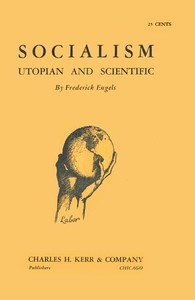
Socialism, Utopian and Scientific by Friedrich Engels
Let's be honest, a book with 'scientific' in the title by a 19th-century philosopher doesn't sound like a page-turner. But stick with me. 'Socialism, Utopian and Scientific' is actually Engels trying to do some serious myth-busting for a general audience. He takes three chapters from his longer, denser work Anti-Dühring and repackages them into this more digestible pamphlet.
The Story
There isn't a plot in the novel sense. Instead, Engels lays out an argument. First, he introduces the 'Utopian' socialists—thinkers like Saint-Simon, Fourier, and Owen. He gives them credit for critiquing early capitalism and imagining better societies, but says their ideas were doomed. They were building castles in the air, based on moral appeals and perfect blueprints, hoping the rich and powerful would see the light.
Then, he unveils the 'Scientific' part. This is the core of the book. Engels explains that Marx's great contribution was applying a materialist lens to history. He argues that social change isn't driven by great ideas or heroic individuals, but by shifts in how we produce stuff—from feudalism to capitalism. The real conflict, he says, is between the working class (proletariat) who make everything and the owning class (bourgeoisie) who profit from it. Socialism, in this view, isn't a wish; it's the predicted next step when capitalism's inherent crises (like overproduction and unemployment) become too explosive to manage.
Why You Should Read It
I picked this up to understand the 'why' behind the 'what.' It’s the foundational text that moved socialism from a feeling of injustice to a structured theory of history. Reading it, you get why this ideology gripped millions. It presents history not as a random sequence of kings and wars, but as a logical, almost mechanical process. There's a powerful, cold clarity to it. Even if you completely disagree with the conclusions, seeing how the argument is built is fascinating. It makes you look at the modern economy—the gig work, the boom-and-bust cycles, the vast inequalities—and wonder if some of Engels's 19th-century diagnoses still ring true.
Final Verdict
This is the book for the curious non-expert. It's perfect for anyone interested in political history, economics, or philosophy who wants to go beyond the soundbites and understand one of the defining ideologies of the last two centuries. It's short, direct, and surprisingly accessible for a theoretical work. Don't expect a neutral presentation—Engels is a true believer making his best case. But if you want to have an informed opinion on socialism, reading it straight from the source is essential. Think of it as the original manifesto's smarter, slightly more patient cousin.
This title is part of the public domain archive. Use this text in your own projects freely.
James Moore
2 years agoThe methodology used in this work is academically sound.
Emily Hill
1 year agoBeautifully written.
Aiden Lopez
1 year agoFive stars!
Mark Johnson
1 year agoRead this on my tablet, looks great.







James White
3 weeks agoClear, concise, and incredibly informative.