About 254 minutes
The Boy Scouts on Belgian Battlefields — Text and Context
Childrens Adventures
58,287 recorded words. 8 minutes difference from this book's estimate.
View Gutenberg source #29991
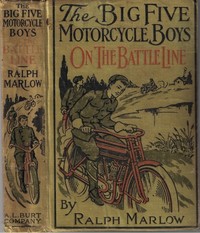
For The Big Five Motorcycle Boys on the Battle Line; Or, With the Allies in France — Text and Context, the stored edition analysis reports 60,135 words, 4 hr 22 min estimated reading time, and 6 detected text sections.
The text analysis averages about 23.0 words per sentence, while the detected sections provide another way to judge how the source is divided.
Project Gutenberg metadata also associates the work with “Boys -- Juvenile fiction,” connecting these edition facts with the source record’s subject description.
Explore this collection
These alternatives are selected using recorded categories and estimated reading time.
About 254 minutes
Childrens Adventures
58,287 recorded words. 8 minutes difference from this book's estimate.
View Gutenberg source #29991About 253 minutes
Childrens Adventures
58,091 recorded words. 9 minutes difference from this book's estimate.
View Gutenberg source #32365About 272 minutes
Childrens Adventures
62,543 recorded words. 10 minutes difference from this book's estimate.
View Gutenberg source #30147Search stored excerpts and compare books → Choose by your preferences →
Choices use stored catalog measurements. Estimates vary with reading speed. A shared category is a catalog label, not a claim that two books have the same argument or literary quality.
Search reads excerpt text stored with this catalog and links to its associated Gutenberg record. The connection is stored in the site database; this tool does not recheck that every excerpt is word-for-word identical to that external record. Excerpt search does not cover every chapter and does not verify historical publication dates.
Catalog snapshot checked: 2026-09-26. Coverage: 93 public books, 93 available source excerpts.
Calculated from edition completeness, EPUB availability, text structure and catalogue metadata. Not a user rating.
Total of 100 points, scaled to a 2.5-5.0 range. Editions with an empty description or a missing EPUB file are not scored.
Public-domain source text
The source text is kept in the dedicated reader, separate from this catalogue record and its commentary.
The story opens on the streets of Antwerp as the Big Five Motorcycle Boys split up: Elmer and Rooster sail for London due to a family emergency, while Rod, Josh, and Hanky Panky stay behind to continue their journey through Belgium and France. The dialogue immediately establishes the group's nicknames—"Rooster" for his boasting, "Hanky Panky" for his tricks—and their collective unease as war encroaches. The boys' motorcycles, repeatedly called "bully machines," are both their means of escape and a source of vulnerability when petrol runs low.
The excerpts show the war as a series of obstacles to be navigated on two wheels. Rod, Josh, and Hanky Panky do not fight; they observe and dodge. The road is littered with "ragged holes" from shells, broken caissons, and discarded guns. The boys must "pick their way" rather than fly, a shift from the speed implied by the series title. Their mission is not military but logistical: securing fuel from a field hospital using a surgeon's order. The narrative focuses on the physical environment—craters, vehicles, prisoners, and peasants—rather than on combat. The war is a landscape to be traversed, not a battle to be joined.
The boys' speech reveals their mounting tension. Josh ducks involuntarily at a "spiteful crack" from a gun. Hanky Panky is "white of face" after recent experiences, and Rod admits the sights "will haunt us for a long time." The author uses colloquial nicknames and exclamations ("Oh! shucks!") to maintain a youthful tone, but the content undercuts it. The phrase "serious pickle" for a lack of petrol contrasts sharply with the surrounding destruction. The boys' emotional state is conveyed through physical reactions—ducking, paling—rather than introspection, keeping the narrative action-oriented even as it acknowledges fear.
Petrol scarcity drives the plot in the later excerpt. Rod reveals their tanks are nearly empty, and Josh admits he was about to ask about it. The solution comes from an army surgeon who gives them a paper to refill at a general supply station. This moment highlights the boys' dependence on adult authority and military infrastructure. The author notes that every gallon in the country has been seized by the military, and what little the Germans didn't confiscate. The fuel stop becomes a pivot: after it, Hanky Panky turns his back on the field hospital "with a thankful heart." The journey continues, but the road is now crowded with wounded, prisoners, and peasants—a sign that the war is closing in.
Readers should note how the author balances the series' formula—plucky boys, fast motorcycles, exotic settings—with the grim specifics of World War I. The excerpts show a world where even a joyride requires a military pass. The nicknames and slang may feel dated, but they serve to keep the protagonists recognizably youthful against a backdrop of adult conflict. Pay attention to what the boys don't say: there is no talk of heroism or victory, only of getting out.
Reading about the Big Five leaning on that surgeon’s pass made me remember the first time I rode my bike past our old barn, alone, and felt the weight of needing permission just to move forward. Years later, flipping through Minnie's Pet Horse — Context and Discussion, I felt that same quiet ache—how even a simple journey depends on trust someone else extends, however small.
Your answers remain private and are stored only in this browser.