About 441 minutes
Cuore (Heart): An Italian Schoolboy's Journal — Edition Insights
Childrens Adventures
101,353 recorded words. 94 minutes difference from this book's estimate.
View Gutenberg source #28961
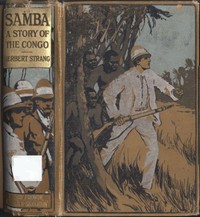
For Samba: A Story of the Rubber Slaves of the Congo — Reading Companion, the stored edition analysis reports 123,002 words, 8 hr 55 min estimated reading time, and 11 detected text sections.
The text analysis averages about 17.1 words per sentence, while the detected sections provide another way to judge how the source is divided.
Project Gutenberg metadata also associates the work with “Forced labor -- Congo (Democratic Republic) -- Juvenile fiction,” connecting these edition facts with the source record’s subject description.
Explore this collection
These alternatives are selected using recorded categories and estimated reading time.
About 441 minutes
Childrens Adventures
101,353 recorded words. 94 minutes difference from this book's estimate.
View Gutenberg source #28961About 396 minutes
Childrens Adventures
90,871 recorded words. 139 minutes difference from this book's estimate.
View Gutenberg source #35178About 390 minutes
Childrens Adventures
89,534 recorded words. 145 minutes difference from this book's estimate.
View Gutenberg source #28179Search stored excerpts and compare books → Choose by your preferences →
Choices use stored catalog measurements. Estimates vary with reading speed. A shared category is a catalog label, not a claim that two books have the same argument or literary quality.
Search reads excerpt text stored with this catalog and links to its associated Gutenberg record. The connection is stored in the site database; this tool does not recheck that every excerpt is word-for-word identical to that external record. Excerpt search does not cover every chapter and does not verify historical publication dates.
Catalog snapshot checked: 2026-09-26. Coverage: 93 public books, 93 available source excerpts.
Calculated from edition completeness, EPUB availability, text structure and catalogue metadata. Not a user rating.
Total of 100 points, scaled to a 2.5-5.0 range. Editions with an empty description or a missing EPUB file are not scored.
Public-domain source text
The source text is kept in the dedicated reader, separate from this catalogue record and its commentary.
The novel opens with a Congo proverb—'Botofé bo le iwa!—Rubber is Death!'—that immediately signals its central critique. Strang, writing in 1906, frames the story as a deliberate exposé of King Leopold II's Congo Free State, where rubber extraction is built on forced labor and depopulation. The preface, co-verified by missionaries Rev. J. H. Harris and Mrs. Harris, claims the book aims 'to show, within necessary limitations, what the effect of the white man's rule has been.' This editorial note examines the authorial choices in diction, dialogue, and description that shape the narrative's moral and political stance.
Strang's diction oscillates between adventure-story bravado and reformist condemnation. In the buffalo hunt excerpt, Jack's elation at 'bagging his first big game' is rendered in the language of sporting triumph: 'the delight of bagging their first big game could appreciate his elation and excitement.' Yet the preface uses stark, statistical language—'the population is annually reduced, under King Leopold's rule, by at least a hundred thousand'—and labels the system 'a disregard of liberty, an indifference to suffering, a destruction of human life, almost inconceivable.' This juxtaposition creates a tension between the boy's adventure frame and the adult horror of the context. The word 'rubber' itself becomes a loaded term, repeated in the proverb and the subtitle, linking the commodity to death.
Dialogue in the excerpt reveals power hierarchies through language choice. Jack, the white American protagonist, speaks English; Samba, the Congolese boy, replies in local terms like 'Njenaki!' (an exclamation of agreement or thanks). The interpreter Lepoko mediates between Jack and the chiefs, whose argument over who killed the buffalo is rendered in 'loud and fierce' gesticulation that Jack cannot understand. Strang uses this linguistic barrier to underscore the colonial dynamic: the white hunter controls the rifle and the narrative, while African voices are filtered or untranslated. The chiefs' quarrel, though opaque to Jack, hints at tensions among the colonized. The dialogue thus serves both plot and theme, showing how language—or its absence—shapes power.
Strang's descriptive passages often adopt Jack's perspective, aligning the reader with the hunter's eye. The buffalo hunt is described with technical precision: 'the heavy sporting rifle,' 'the red buffaloes of the district, a good deal smaller than the kind he had seen in America,' and the shot 'through the brain.' This specificity grounds the adventure in verisimilitude. Yet the same gaze that notes the buffalo's size also registers the chiefs' 'chagrin' and Samba's 'beaming smile.' The description of Samba's intervention—'his dark body darting between himself and a second buffalo'—frames the boy as a heroic, almost instinctive protector. The landscape is functional, not picturesque: 'the country became so open that to approach nearer unseen was impossible.' Description here serves the action and the moral: the white boy's thrill is repeatedly undercut by the reality of African agency and danger.
The narrative structure in the excerpt moves from hunting excitement to sudden crisis to a quarrel among the Africans, then back to Jack's reflection. This pattern—action, interruption, aftermath—mirrors the larger structure of the novel, where adventure sequences are punctuated by reminders of the rubber regime. The buffalo hunt is not just a sporting episode; it becomes a scene of near-death and cultural misunderstanding. Strang inserts a historical parallel: 'As happened once to Stanley travelling between Vivi and Isangila, the suddenness of the onset for the moment paralysed his will.' This allusion to Henry Morton Stanley, the explorer associated with Leopold's project, links Jack's personal danger to the broader colonial narrative. The structure thus weaves individual peril into systemic critique, using the adventure genre to carry reformist content.
Readers attentive to Strang's authorial choices will notice how the adventure plot is repeatedly interrupted by the weight of historical reference and moral commentary. The buffalo hunt, for instance, is not merely a test of skill but a microcosm of colonial encounter, where language, power, and violence intersect. The novel's effectiveness lies in this layering: the boy's story never fully escapes the shadow of the rubber trade. Approaching the text with an eye to its diction, dialogue, and descriptive strategies reveals how Strang uses the conventions of juvenile fiction to advocate for Congo reform.
There’s something quietly startling in Strang’s Congo—how easily human voices get lost beneath the noise of empire. I found myself thinking about that while rereading A Book of Cheerful Cats and Other Animated Animals — Reading Notes, where every creature, however small, gets its say. Perhaps we always seek out the softer witnesses when the real ones grow too heavy.
A brief reflection can help important ideas stay with you longer.