About 385 minutes
Hans Brinker; Or, The Silver Skates — Themes and Context
Childrens Adventures
88,380 recorded words. 5 minutes difference from this book's estimate.
View Gutenberg source #34378
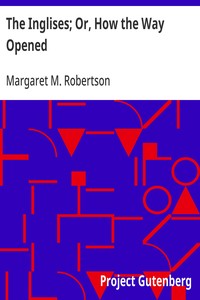
The source record for The Inglises; Or, How the Way Opened — A Closer Reading measures this digital text at 89,534 words, 6 hr 30 min estimated reading time, and 8 detected text sections.
The text analysis averages about 17.7 words per sentence, while the detected sections provide another way to judge how the source is divided.
Project Gutenberg metadata also associates the work with “Christian life -- Juvenile fiction,” connecting these edition facts with the source record’s subject description.
Explore this collection
These alternatives are selected using recorded categories and estimated reading time.
About 385 minutes
Childrens Adventures
88,380 recorded words. 5 minutes difference from this book's estimate.
View Gutenberg source #34378About 396 minutes
Childrens Adventures
90,871 recorded words. 6 minutes difference from this book's estimate.
View Gutenberg source #35178About 377 minutes
Childrens Adventures
86,578 recorded words. 13 minutes difference from this book's estimate.
View Gutenberg source #35985Search stored excerpts and compare books → Choose by your preferences →
Choices use stored catalog measurements. Estimates vary with reading speed. A shared category is a catalog label, not a claim that two books have the same argument or literary quality.
Search reads excerpt text stored with this catalog and links to its associated Gutenberg record. The connection is stored in the site database; this tool does not recheck that every excerpt is word-for-word identical to that external record. Excerpt search does not cover every chapter and does not verify historical publication dates.
Catalog snapshot checked: 2026-09-26. Coverage: 93 public books, 93 available source excerpts.
Calculated from edition completeness, EPUB availability, text structure and catalogue metadata. Not a user rating.
Total of 100 points, scaled to a 2.5-5.0 range. Editions with an empty description or a missing EPUB file are not scored.
Public-domain source text
The source text is kept in the dedicated reader, separate from this catalogue record and its commentary.
The opening pages of The Inglises immediately establish a pattern of contrast between sheltered interiors and threatening exteriors. Mrs. Inglis and her son David watch from a window as rain and sleet lash against the glass, unable to hear the minister’s wagon over the moaning wind. The house is “bright with fire-light,” a picture of comfort set against the “dark and stormy night.” This juxtaposition recurs throughout the excerpts: the family gathers around the hearth while the road called Hardscrabble—a name that signals difficulty—lies treacherous in the dark. Robertson uses weather not merely as atmosphere but as a structural device, marking transitions between scenes and underscoring the precariousness of movement between home and the wider world.
The name “Hardscrabble” appears early, spoken by David as he imagines the road his father must travel. It is a telling detail: the hill is not just a geographical feature but a recurring emblem of struggle. Robertson returns to such place-names to anchor the story in a specific, rugged landscape. The township of Gourlay contains two villages, Gourlay Centre and Gourlay Corner, and the minister preaches also at the North Gore—a settlement so remote that some residents “would never have heard the Gospel preached” without his visits. The physical difficulty of reaching these places is emphasized: “the way was long and the roads rough at the best of seasons.” Movement between these points—home, village, schoolhouse—structures the narrative, each journey carrying risk and requiring effort.
Robertson repeatedly uses light to signal shifts in mood and location. The Inglis home is consistently associated with firelight and lanterns: David is told to “be ready with the lantern” when his father returns. In contrast, the storm outside is described as “very dark,” with village lights “but dimly visible.” Later, a boat is brought in among willows “almost dark,” and the family’s Sunday-school work takes place “down on Muddy Lane”—a name that suggests both physical and moral obscurity. These visual cues do not merely decorate the prose; they help the reader track the characters’ movements between safety and exposure, between the known and the uncertain.
In one extended episode, a boat becomes a focal point for decisions about space and belonging. The young people debate whether to leave it among the willows overnight or send for it later. Jem is “delighted with the idea” of leaving it, while David gives his mother “a doubtful look.” The boat is a threshold object—neither fully domestic nor fully wild—and its placement reflects the characters’ differing attitudes toward risk and propriety. Robertson uses such concrete details to dramatize small moral choices. The boat also facilitates movement between the Inglis home and the Oswald household, whose “simple arrangements” are contrasted with Miss Oswald’s more formal expectations. The boat, like the road Hardscrabble, is a means of connection that also tests judgment.
The excerpts contain layered dialogue that reveals family dynamics through tone and interruption. Frank calls himself “one of the children” when visiting, while Philip is treated as a stranger. Jessie and Ned interrupt with tales of Sunday-school wagers and broken parasols, their chatter contrasting with the mother’s quiet authority. Robertson captures the rhythm of a large household: eager voices overlap, and the mother redirects without scolding. Notably, the children’s speech is not idealized; they tell “tales out of school” and squabble over seating by the fire. These exchanges ground the moral concerns of the novel in everyday interaction, making the family feel lived-in rather than exemplary.
Readers attentive to Robertson’s handling of space will notice how often the narrative pauses at thresholds—windows, doors, gates—before a character steps out or returns. The weather, the condition of the roads, and the time of day are never incidental; they govern what is possible. This editorial note has focused on structure and recurring images, but the same attention to physical detail extends to the moral choices the characters face. The way opens, as the subtitle promises, but it opens through small, concrete acts of care and risk.
I kept thinking about how The Inglises moves between light and shadow, and how that same quiet rhythm of hope against hardship seems to breathe through The Orphans of Glen Elder — A Closer Reading. It’s less a comparison than a feeling—like recognizing a voice in another room, gentle and familiar.
Capture what you thought, learned, and would like to remember.