About 282 minutes
The Broncho Rider Boys on the Wyoming Trail Or, A Mystery of the Prairie Stampede — Reading Companion
Childrens Adventures
64,671 recorded words. 4 minutes difference from this book's estimate.
View Gutenberg source #39578
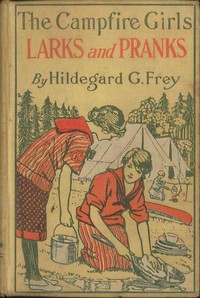
The Camp Fire Girls' Larks and Pranks; Or, The House of the Open Door — Reading Notes can be approached with a clearer sense of reading commitment from its source measurements: 63,804 words, 4 hr 38 min estimated reading time, and 9 detected text sections.
The text analysis averages about 17.0 words per sentence, while the detected sections provide another way to judge how the source is divided.
Project Gutenberg metadata also associates the work with “Friendship -- Juvenile fiction,” connecting these edition facts with the source record’s subject description.
Explore this collection
These alternatives are selected using recorded categories and estimated reading time.
About 282 minutes
Childrens Adventures
64,671 recorded words. 4 minutes difference from this book's estimate.
View Gutenberg source #39578About 272 minutes
Childrens Adventures
62,543 recorded words. 6 minutes difference from this book's estimate.
View Gutenberg source #30147About 286 minutes
Childrens Adventures
65,670 recorded words. 8 minutes difference from this book's estimate.
View Gutenberg source #30881Search stored excerpts and compare books → Choose by your preferences →
Choices use stored catalog measurements. Estimates vary with reading speed. A shared category is a catalog label, not a claim that two books have the same argument or literary quality.
Search reads excerpt text stored with this catalog and links to its associated Gutenberg record. The connection is stored in the site database; this tool does not recheck that every excerpt is word-for-word identical to that external record. Excerpt search does not cover every chapter and does not verify historical publication dates.
Catalog snapshot checked: 2026-09-26. Coverage: 93 public books, 93 available source excerpts.
Calculated from edition completeness, EPUB availability, text structure and catalogue metadata. Not a user rating.
Total of 100 points, scaled to a 2.5-5.0 range. Editions with an empty description or a missing EPUB file are not scored.
Public-domain source text
The source text is kept in the dedicated reader, separate from this catalogue record and its commentary.
The novel opens with a secret meeting in a barn, where a password—'Kolah Olowan'—and bird-call signals establish the Winnebagos' club as a playful, ritual-bound society. The 'House of the Open Door' is both a literal barn loft and a symbol of inclusive fellowship, yet the text immediately introduces friction: Veronica, a newcomer, holds herself apart, judging the others by class rather than character. The author uses weather and setting to mirror mood—a 'big yellow hunter’s moon' grinning at earthly antics, or a January thaw that turns streets to slush, foreshadowing the messy entanglements to come.
The Winnebagos' meeting place is a barn whose upper room is 'bright and cheerful' despite its dark exterior, with a wood fire and a buffalo robe painted by the girls. This contrast between outside and inside mirrors the group's dynamic: rough-hewn but warm. The password ritual—'Other Council Fires were here before'—ties them to a larger Camp Fire tradition, while the barn's transformation from storage space to lodge underscores their resourcefulness. The author lingers on sensory details: the 'rustling' leaves, the 'whippoorwill' call, the 'carol of the bluebird.' These sounds create a secret language that binds the girls, yet also excludes those who don't know the code—a subtle hint at the social barriers Veronica erects.
Katherine Adams is described as 'big, clumsy, awkward,' with a 'flyaway appearance' and an 'unmusical voice.' Veronica, by contrast, is dainty, artistic, and class-conscious, believing Katherine to be a 'peasant' and thus 'an inferior.' The text makes clear that Veronica 'failed to appreciate the wonderful magnetism of Katherine’s personality.' This tension erupts when Katherine accidentally lures Veronica's pedigreed poodle, Fifi, into the slush. The dog's 'pedigree was considerably longer than he was,' a wry detail that underscores the absurdity of class distinctions. Yet the narrative does not villainize Veronica; it notes she is 'gradually thawing,' even asking to learn 'slumgullion'—a humble camp dish. The conflict is less about malice than about incompatible values: democratic good nature versus inherited snobbery.
The chapter titled 'A Tempest in a Teapot' signals that the girls' conflicts are small-scale but intense. Katherine's errand to fetch a banjo sets off a chain of mishaps: Fifi follows her, gets muddy, and the resulting uproar is described as a 'bomb' blowing up. The author uses domestic, almost trivial triggers—a sugar cookie, a muddy puddle—to escalate tensions. This pattern of minor incidents leading to major misunderstandings recurs throughout the excerpts. The girls' reactions are exaggerated but sincere: whispered conferences, delighted squeezes, and hurt feelings. The narrative voice remains light, even comic, but the underlying stakes are real: belonging, acceptance, and the effort required to bridge differences. The 'Open Door' ideal is tested not by external threats but by internal prejudices.
Readers will find that the novel's pleasures lie less in plot than in the precise observation of group dynamics. The Winnebagos' world is one where a muddy poodle can become a diplomatic incident, and where a girl's willingness to learn 'slumgullion' signals a shift in allegiance. Pay attention to the recurring motifs of doors, passwords, and thresholds—they mark not just physical spaces but the characters' willingness to let others in.
There’s something tender about the Winnebagos’ barn-door welcome, how a prank could still leave room for grace. It makes me think of Briarwood Girls — Inside the Classic, where the same quiet tug between belonging and being an outsider lingers. I suppose I’ve carried both houses with me, long after the last page turned.
Use these questions to collect your thoughts before moving on.