About 218 minutes
Pemrose Lorry, Camp Fire Girl — Edition Insights
Childrens Adventures
50,015 recorded words. 2 minutes difference from this book's estimate.
View Gutenberg source #31748
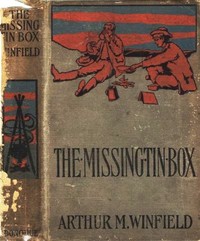
The Missing Tin Box; Or, The Stolen Railroad Bonds — A Closer Reading can be approached with a clearer sense of reading commitment from its source measurements: 49,565 words, 3 hr 36 min estimated reading time, and 6 detected text sections.
The text analysis averages about 10.2 words per sentence, while the detected sections provide another way to judge how the source is divided.
Project Gutenberg metadata also associates the work with “Orphans -- Juvenile fiction,” connecting these edition facts with the source record’s subject description.
Explore this collection
These alternatives are selected using recorded categories and estimated reading time.
About 218 minutes
Childrens Adventures
50,015 recorded words. 2 minutes difference from this book's estimate.
View Gutenberg source #31748About 211 minutes
Childrens Adventures
48,455 recorded words. 5 minutes difference from this book's estimate.
View Gutenberg source #37554About 226 minutes
Childrens Adventures
51,770 recorded words. 10 minutes difference from this book's estimate.
View Gutenberg source #36423Search stored excerpts and compare books → Choose by your preferences →
Choices use stored catalog measurements. Estimates vary with reading speed. A shared category is a catalog label, not a claim that two books have the same argument or literary quality.
Search reads excerpt text stored with this catalog and links to its associated Gutenberg record. The connection is stored in the site database; this tool does not recheck that every excerpt is word-for-word identical to that external record. Excerpt search does not cover every chapter and does not verify historical publication dates.
Catalog snapshot checked: 2026-09-26. Coverage: 93 public books, 93 available source excerpts.
Calculated from edition completeness, EPUB availability, text structure and catalogue metadata. Not a user rating.
Total of 100 points, scaled to a 2.5-5.0 range. Editions with an empty description or a missing EPUB file are not scored.
Public-domain source text
The source text is kept in the dedicated reader, separate from this catalogue record and its commentary.
The novel opens with a hushed conversation on a Pennsylvania Railroad ferry-boat, where two men discuss bonds worth “close on to eighty thousand dollars.” The speaker, Allen, reveals the bonds are kept in a private safe, while his companion Hardwick worries about a shabbily-dressed boy nearby who might overhear. This scene immediately establishes the central mystery and the author’s method: using dialogue to convey plot-critical information while also signaling danger through the boy’s presence. The boy, Hal Carson, is an orphan, and his position as an unnoticed listener becomes a recurring device.
Stratemeyer relies heavily on dialogue to advance the plot and reveal character. In the ferry scene, the exchange between Allen and Hardwick is clipped and laden with financial details—bonds, a safe, a friend named Mr. Mason—yet the men speak in half-sentences and warnings (“Hush!”). This creates a sense of secrecy and urgency. Later, when Dick Ferris confronts a boy who threw a snowball, the dialogue shifts to colloquial threats (“Lemme go!”) and legal posturing (“I fancy I know my own business best”). The author uses contrasting speech patterns: the conspirators speak in calculated, low tones, while street characters use slang and exclamations. This distinction helps readers track alliances and social positions without explicit narration.
The story moves through specific, gritty locations: a ferry, a snow-covered street, a tenement alley, and a dingy apartment. These are not mere backdrops but active elements in the plot. Hal hides in an alley to eavesdrop, follows Ferris up “rickety stairs,” and peers through a keyhole to observe a dissipated man named Macklin. The author describes the tenement as having “dirty, dingy” houses and a dark hallway, emphasizing the physical and moral decay of the environment. These settings reinforce the theme of hidden danger—the bonds are concealed in a safe, but the real threat lurks in the shadows of the city. Stratemeyer uses the urban landscape to create obstacles and opportunities for Hal’s investigation.
Hal Carson is introduced as a “shabbily-dressed boy of sixteen” who appears passive—eyes closed, hands clasped—yet he is actively gathering information. The author positions him as an observer rather than an initiator in the early chapters. When Ferris searches for Hal after the snowball incident, Hal “kept well hidden,” and later he “managed to skulk up” to overhear a conversation. His movements are reactive, driven by the need to avoid detection. This limited agency reflects his orphan status and lack of resources, but it also makes his eventual actions more significant. Stratemeyer builds suspense by showing Hal’s vulnerability: he is a boy in a world of adults who threaten, manipulate, and dismiss him.
Eavesdropping is the primary means by which Hal gathers evidence. He overhears the ferry conversation, listens at a keyhole, and follows Ferris through the tenement. The author repeatedly places Hal in positions where he can hear but not be seen—behind buildings, in dark hallways, at half-open doors. This motif extends to the physical objects of the plot: the tin box itself is hidden, and the bonds are concealed in a safe. Even characters’ motives are hidden, as when Hardwick whispers to Allen or when Ferris delivers a letter in secret. Stratemeyer uses concealment to drive the narrative forward, making the act of discovery—whether of a conversation or a box—the central dramatic action.
Readers should pay close attention to who speaks and who listens in each scene. Stratemeyer often withholds information from characters but not from the reader, creating dramatic irony. The excerpts suggest that Hal’s success depends on his ability to remain unnoticed and to interpret what he hears. The novel rewards careful reading of dialogue and setting, as both carry clues to the mystery of the missing tin box.
That old Stratemeyer story, with Hal tracing those railroad bonds through shadowy city corners, stayed with me because every conversation felt weighted, each glance held a clue. It reminded me of the quiet way Minnie's Pet Dog — A Reader’s Guide lingers—not for plot, but for the tenderness between the lines. Sometimes the gentlest tales leave the deepest impression, don't they?
Answer a few questions and save a private reflection on this device.