About 227 minutes
The Motor Girls on the Coast; or, The Waif From the Sea — Edition Insights
Childrens Adventures
52,001 recorded words. 1 minutes difference from this book's estimate.
View Gutenberg source #32024
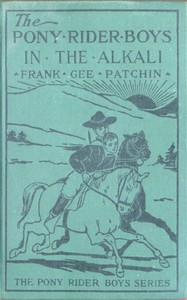
Before opening The Pony Rider Boys in the Alkali; Or, Finding a Key to the Desert Maze — Inside the Classic, the edition data offers a quick orientation: 51,770 words, 3 hr 46 min estimated reading time, and 7 detected text sections.
The text analysis averages about 12.1 words per sentence, while the detected sections provide another way to judge how the source is divided.
Project Gutenberg metadata also associates the work with “Horsemanship -- Juvenile fiction,” connecting these edition facts with the source record’s subject description.
Explore this collection
These alternatives are selected using recorded categories and estimated reading time.
About 227 minutes
Childrens Adventures
52,001 recorded words. 1 minutes difference from this book's estimate.
View Gutenberg source #32024About 218 minutes
Childrens Adventures
50,015 recorded words. 8 minutes difference from this book's estimate.
View Gutenberg source #31748About 234 minutes
Childrens Adventures
53,622 recorded words. 8 minutes difference from this book's estimate.
View Gutenberg source #37487Search stored excerpts and compare books → Choose by your preferences →
Choices use stored catalog measurements. Estimates vary with reading speed. A shared category is a catalog label, not a claim that two books have the same argument or literary quality.
Search reads excerpt text stored with this catalog and links to its associated Gutenberg record. The connection is stored in the site database; this tool does not recheck that every excerpt is word-for-word identical to that external record. Excerpt search does not cover every chapter and does not verify historical publication dates.
Catalog snapshot checked: 2026-09-26. Coverage: 93 public books, 93 available source excerpts.
Calculated from edition completeness, EPUB availability, text structure and catalogue metadata. Not a user rating.
Total of 100 points, scaled to a 2.5-5.0 range. Editions with an empty description or a missing EPUB file are not scored.
Public-domain source text
The source text is kept in the dedicated reader, separate from this catalogue record and its commentary.
Frank Gee Patchin opens The Pony Rider Boys in the Alkali with a deliberate contrast between the boys' expectations and the guide's terse corrections. Stacy Brown's complaint—"If this is the desert, then I think I prefer mountains"—is immediately undercut by Tom Parry's flat reply: "It is not the desert." This pattern of deflated anticipation recurs throughout the excerpts, with the guide's clipped statements ("One hundred in the shade. Isn't that matter enough?") serving as a counterweight to the boys' exuberance. Patchin uses dialogue not merely to advance plot but to establish a hierarchy of knowledge: the guide speaks in facts, the boys in reactions.
Patchin's word choices for the landscape are precise and sensory. The desert is repeatedly called a "maze"—the subtitle itself promises a "Key to the Desert Maze"—and the text reinforces this with references to "amber haze," "baking alkali," and "black maze." These phrases avoid generic description; they evoke specific conditions of light, heat, and color. The guide's warning about a rifle bullet falling "on the baking alkali" gives the desert a physical weight, while the coyotes' "weird wailing" is described as coming from "every peak in the range" and "out in the black maze," creating a sense of enveloping sound. Patchin rarely uses abstract terms for the setting; instead, he relies on concrete nouns and active verbs—"floundering," "howl," "protesting"—that keep the environment in motion.
The dialogue reveals character through rhythm and vocabulary. Stacy Brown, nicknamed "Chunky," speaks in exaggerated complaints and boasts, while Ned Rector responds with teasing jibes. Tad Butler's asides are quieter: "And feel it, too, I guess" he mutters under his breath. Professor Zepplin uses formal, deferential language—"We are entirely in his hands and it is not for us to question the wisdom of his decision"—which contrasts sharply with the boys' slang and the guide's brevity. Patchin also layers voices in the campfire scene: Stacy's impromptu song, with its mock-heroic lines about losing pants and hiding ants, is interrupted by the coyotes' "Ki-i-i-i-o-o-o!" The howl becomes a kind of choral response, turning the desert into an active participant in the dialogue.
Patchin uses humor to manage tension and pace. The coyote serenade that follows Stacy's song is both comic and menacing: the boys laugh, but the guide notes the animals are "expressing their indignation." Later, Stacy creeps out in his night clothes to throw a can of condensed milk at a coyote—a scene that balances slapstick (the can hits "right between the eyes") with the real danger of a wild animal. The humor often stems from the boys' misjudgment of the desert's scale. When Stacy asks why they cannot shoot at the coyotes, the guide's reply—"It will alarm the wild horses"—shifts the frame from immediate threat to a larger ecological logic. Patchin lets the joke land, but the guide's explanation reminds readers that the desert operates on its own terms.
Patchin's descriptive passages are economical, often embedded in action or dialogue. The guide is introduced as "a splendid type of the plainsman" with "bronzed cheeks fairly glistening in the sunlight," but the description is immediately functional: he sits "motionless" peering into the "amber haze." The setting is never described in isolation; it is always filtered through a character's perception or a practical concern. When the Professor asks about the weather, the guide's reply—"One hundred in the shade"—is both a fact and a rebuke. Patchin trusts the reader to infer the heat from that single line. Similarly, the coyotes' howl is not described at length; it is rendered phonetically ("Ki-i-i-i-o-o-o!") and then labeled "weird wailing." The effect is immersive without being overwritten.
Patchin's authorial choices in The Pony Rider Boys in the Alkali reward attention to how he builds a world through talk and understatement. The guide's silence is as telling as the boys' chatter; the desert's presence is felt in what is left unsaid. Readers may find that the most revealing moments are not the action set-pieces but the pauses—the guide peering into the haze, the coyotes' chorus interrupting a song. These details, drawn from the excerpts, suggest a writer who understood that a landscape becomes real when characters react to it in their own voices.
That rain fell all afternoon while I lost myself in the alkali's dry humor, the guide's few words carrying more weight than the boys' chatter. It made me wonder about voices left unheard. Later, I picked up Amy in Acadia: A Story for Girls — Story, Setting & Ideas almost without thinking, and found that same quiet attention to place. Two deserts, two silences, somehow the same calm.
Capture what you thought, learned, and would like to remember.