About 227 minutes
The Motor Girls on the Coast; or, The Waif From the Sea — Edition Insights
Childrens Adventures
52,001 recorded words. 7 minutes difference from this book's estimate.
View Gutenberg source #32024
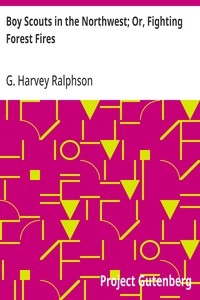
The catalog record for Boy Scouts in the Northwest; Or, Fighting Forest Fires — Story, Setting & Ideas provides practical reading context through 53,622 words, 3 hr 54 min estimated reading time, and 6 detected text sections.
The text analysis averages about 15.2 words per sentence, while the detected sections provide another way to judge how the source is divided.
Project Gutenberg metadata also associates the work with “Boy Scouts -- Juvenile fiction,” connecting these edition facts with the source record’s subject description.
Explore this collection
These alternatives are selected using recorded categories and estimated reading time.
About 227 minutes
Childrens Adventures
52,001 recorded words. 7 minutes difference from this book's estimate.
View Gutenberg source #32024About 226 minutes
Childrens Adventures
51,770 recorded words. 8 minutes difference from this book's estimate.
View Gutenberg source #36423About 245 minutes
Childrens Adventures
56,313 recorded words. 11 minutes difference from this book's estimate.
View Gutenberg source #30845Search stored excerpts and compare books → Choose by your preferences →
Choices use stored catalog measurements. Estimates vary with reading speed. A shared category is a catalog label, not a claim that two books have the same argument or literary quality.
Search reads excerpt text stored with this catalog and links to its associated Gutenberg record. The connection is stored in the site database; this tool does not recheck that every excerpt is word-for-word identical to that external record. Excerpt search does not cover every chapter and does not verify historical publication dates.
Catalog snapshot checked: 2026-09-26. Coverage: 93 public books, 93 available source excerpts.
Calculated from edition completeness, EPUB availability, text structure and catalogue metadata. Not a user rating.
Total of 100 points, scaled to a 2.5-5.0 range. Editions with an empty description or a missing EPUB file are not scored.
Public-domain source text
The source text is kept in the dedicated reader, separate from this catalogue record and its commentary.
From its opening sentence, Boy Scouts in the Northwest; Or, Fighting Forest Fires establishes a brisk, reportorial tone. The narrative moves quickly from a “sizzling hot afternoon” to the immediate tension of missing comrades, using short declarative sentences and frequent dialogue tags to maintain momentum. This pace, however, is not uniform; the novel alternates between breathless action and slower, more introspective passages that reveal the characters’ internal processes.
The aeroplane sequences showcase Ralphson’s method of slowing time to heighten suspense. When Ned’s machine begins to sag, the prose shifts into a series of conditional clauses: “If it turned… he might secure control… If it did not, he would doubtless fall.” This grammatical structure mirrors the pilot’s split-second calculations, stretching a moment of crisis into a paragraph of hypothetical outcomes. The technical vocabulary—down-tipping currents, lower strata of air—grounds the fantasy in plausible danger, while the stark image of “bleaching bones” and a wrecked aeroplane undercuts any sense of invincibility. Such passages contrast sharply with the earlier, dialogue-driven scenes, where the boys’ banter keeps the tone light and the plot moving forward.
Chapter XI marks a distinct shift in narrative voice. Jimmie’s awakening in a rocky niche is rendered through sensory details—the “drawing sensation” on his skin, the “whirl of dizziness”—that prioritize bodily experience over action. His method of telling time by the stars, learned from watching them “on a dray backed up some alley down near the East river,” introduces a streetwise, observational quality absent from the other scouts’ perspectives. The phrase “geezled by the outlaws” injects a colloquial, almost defiant self-awareness. This section’s slower pacing, with its focus on disorientation and memory, provides a counterweight to the aeroplane’s kinetic peril, suggesting that the novel’s emotional weight often resides in its quieter moments.
The book’s structure relies on abrupt transitions between crisis and recovery. A chapter ending with a plummeting aeroplane gives way to Jimmie’s disoriented stillness, creating a rhythm of tension and release. Ralphson uses these shifts to vary the reader’s engagement: the aeroplane scenes demand rapid attention, while the aftermath allows for character interiority. Notably, the narrative avoids lingering on emotional reactions; even Jimmie’s fear is processed through practical concerns—the time, the wound, the location of his friends. This restraint keeps the focus on problem-solving rather than sentiment, a hallmark of the series’ adventure formula. The pacing thus serves both to entertain and to model the scouts’ resourcefulness under pressure.
Readers attentive to narrative craft will find in Boy Scouts in the Northwest a useful study in how early twentieth-century adventure fiction managed pace. The alternation between rapid-fire dialogue and measured, technical description, along with the occasional shift to a character’s private voice, creates a varied reading experience that rewards close attention to sentence-level choices. The excerpts suggest that Ralphson was as interested in how his characters think as in what they do.
There’s a moment in Boy Scouts in the Northwest where the smoke clears, and the boys sit quietly, not triumphant, just tired—the fire’s roar replaced by crickets. It made me think of Jill’s Red Bag — A Closer Reading and its own hush after small disasters. Both leave you holding your breath a little, remembering peace tastes sharpest right after noise.
Use these questions to collect your thoughts before moving on.