About 176 minutes
Penny Nichols and the Knob Hill Mystery — Story, Setting & Ideas
Childrens Adventures
40,385 recorded words. 0 minutes difference from this book's estimate.
View Gutenberg source #33383
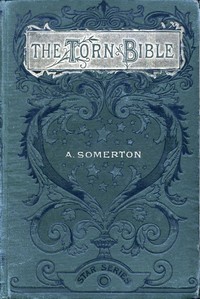
This digital edition of The Torn Bible; Or, Hubert's Best Friend — Reading Notes is described by source-level measurements including 40,341 words, 2 hr 56 min estimated reading time, and 4 detected text sections.
The text analysis averages about 27.8 words per sentence, while the detected sections provide another way to judge how the source is divided.
Project Gutenberg metadata also associates the work with “Christian life -- Juvenile fiction,” connecting these edition facts with the source record’s subject description.
Explore this collection
These alternatives are selected using recorded categories and estimated reading time.
About 176 minutes
Childrens Adventures
40,385 recorded words. 0 minutes difference from this book's estimate.
View Gutenberg source #33383About 176 minutes
Childrens Adventures
40,323 recorded words. 0 minutes difference from this book's estimate.
View Gutenberg source #36189About 177 minutes
Childrens Adventures
40,515 recorded words. 1 minutes difference from this book's estimate.
View Gutenberg source #33754Search stored excerpts and compare books → Choose by your preferences →
Choices use stored catalog measurements. Estimates vary with reading speed. A shared category is a catalog label, not a claim that two books have the same argument or literary quality.
Search reads excerpt text stored with this catalog and links to its associated Gutenberg record. The connection is stored in the site database; this tool does not recheck that every excerpt is word-for-word identical to that external record. Excerpt search does not cover every chapter and does not verify historical publication dates.
Catalog snapshot checked: 2026-09-26. Coverage: 93 public books, 93 available source excerpts.
Calculated from edition completeness, EPUB availability, text structure and catalogue metadata. Not a user rating.
Total of 100 points, scaled to a 2.5-5.0 range. Editions with an empty description or a missing EPUB file are not scored.
Public-domain source text
The source text is kept in the dedicated reader, separate from this catalogue record and its commentary.
The novel opens with a detailed description of Hulney, a rural English village, and its ivy-covered church, which bears a carved gravestone for Hubert Goodwin—a book partly destroyed etched in stone. This image of a damaged Bible recurs throughout the excerpts, serving as both a literal object and a symbol of Hubert's spiritual journey. The dedication addresses eight schoolfellows directly, urging them to read a Bible portion daily, framing the work as an explicit moral instruction.
The opening chapter situates the story in Hulney, a village surrounded by wooded hills and streams. The church, thick with ivy, is linked to historical figures like Margaret of Anjou and soldiers from Flodden Field. But the most striking detail is the gravestone of Hubert Goodwin, aged seventy, with a carved book and loose leaves. This image foreshadows the torn Bible that will become central to the plot. The narrator notes that this stone draws the attention of strangers, hinting at a story behind it. The description is precise: the carving is exquisite, and the inscription includes a partly destroyed book. This visual motif—a damaged sacred text—is established before the narrative proper begins.
During the voyage on the Arctic, Hubert finds himself torn between his deepening faith and his friendship with a refined, worldly companion. The excerpts reveal his internal struggle: he longs to discuss the Bible but fears his friend's reproach. The text states that Hubert 'had not boldness sufficient' to speak, despite his growing anxiety. He prays for a 'beam of light' into his friend's heart, yet hesitates to produce the torn Bible from his pocket. The narrator observes that Hubert's friend is 'quiet, unobtrusive, amiable and kind,' yet his education and eloquence intimidate Hubert. This dynamic—a devout but timid protagonist versus a cultured skeptic—drives the moral tension. Hubert's self-examination, prompted by the doctor's advice, leads him to question why the torn book gives him such delight, but he cannot fully articulate it.
The book's dedication is an unusual feature: Alice Somerton addresses 'Glanville and his eight schoolfellows' directly, explaining that she hopes they will 'imbibe an earnest love and reverence for your Bible.' She echoes Hubert's mother's request to read a portion daily. This paratext frames the novel as a didactic tool, explicitly linking the fictional story to the reader's own conduct. The dedication's tone is affectionate but firm, urging humility, duty, and blessing. It reveals the author's intent to use narrative as moral instruction, a purpose reinforced by the catalog subjects of Christian life, conduct, and repentance. The excerpts show that the novel itself enacts this lesson through Hubert's journey, but the dedication makes the pedagogical aim unmistakable.
Readers approaching The Torn Bible should note that the excerpts focus heavily on Hubert's internal struggles and the symbolic weight of the damaged book. The adventure elements—sea voyages, a wound, a return home—are present but serve as a framework for spiritual reflection. The novel's structure, with chapters titled 'The Torn Bible' and 'What the Torn Bible Had Done for Hubert,' suggests a deliberate progression from crisis to resolution. Pay attention to how the physical state of the Bible mirrors Hubert's own spiritual condition.
The rain kept time with Hubert’s restless pacing in The Torn Bible, that quiet ache for a friend who understood. Afterwards, I sat with the ache, remembering how animals sometimes fill that hollow. It led me, without searching, to Minnie's Pet Horse — Context and Discussion, where a child’s steady companionship with a creature felt like the same gentle answer.
Capture what you thought, learned, and would like to remember.