About 214 minutes
Mary Louise Solves a Mystery — Story, Setting & Ideas
Fairy Moral Tales
49,026 recorded words. 7 minutes difference from this book's estimate.
View Gutenberg source #24578
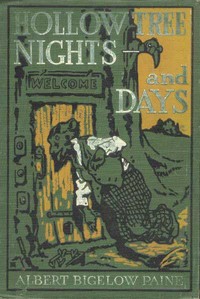
This digital edition of Hollow Tree Nights and Days — A Reader’s Guide is described by source-level measurements including 47,426 words, 3 hr 27 min estimated reading time, and 7 detected text sections.
The text analysis averages about 20.5 words per sentence, while the detected sections provide another way to judge how the source is divided.
Project Gutenberg metadata also associates the work with “Animals -- Juvenile fiction,” connecting these edition facts with the source record’s subject description.
Explore this collection
These alternatives are selected using recorded categories and estimated reading time.
About 214 minutes
Fairy Moral Tales
49,026 recorded words. 7 minutes difference from this book's estimate.
View Gutenberg source #24578About 199 minutes
Fairy Moral Tales
45,556 recorded words. 8 minutes difference from this book's estimate.
View Gutenberg source #25801About 199 minutes
Fairy Moral Tales
45,602 recorded words. 8 minutes difference from this book's estimate.
View Gutenberg source #33948Search stored excerpts and compare books → Choose by your preferences →
Choices use stored catalog measurements. Estimates vary with reading speed. A shared category is a catalog label, not a claim that two books have the same argument or literary quality.
Search reads excerpt text stored with this catalog and links to its associated Gutenberg record. The connection is stored in the site database; this tool does not recheck that every excerpt is word-for-word identical to that external record. Excerpt search does not cover every chapter and does not verify historical publication dates.
Catalog snapshot checked: 2026-09-26. Coverage: 93 public books, 93 available source excerpts.
Calculated from edition completeness, EPUB availability, text structure and catalogue metadata. Not a user rating.
Total of 100 points, scaled to a 2.5-5.0 range. Editions with an empty description or a missing EPUB file are not scored.
Public-domain source text
The source text is kept in the dedicated reader, separate from this catalogue record and its commentary.
This continuation of the Hollow Tree stories opens with a new map and a greeting from the Story Teller and the Artist, establishing a playful frame. The narrative voice is colloquial and intimate, addressing readers directly and weaving in asides about the characters' habits. The excerpt about Mr. 'Possum's ancestors reveals a layered structure: a story within a story, with interruptions from listeners like Mr. Rabbit and Mr. 'Coon. Paine uses repetition of the phrase "didn't notice anything had happened" to comic effect, highlighting the characters' vanity and the storyteller's control.
The narrative voice in Hollow Tree Nights and Days is distinctive for its conversational, almost oral quality. Paine frequently inserts parenthetical remarks and asides, such as "and I judge some of our family didn't do it perfectly." This creates a sense of a storyteller speaking directly to a listener, often with gentle irony. The pace varies: long, winding sentences build detail, while short interjections like "'Sh!" from the audience break the flow. The repetition of "didn't notice anything had happened" after each character's offended reaction slows the narrative and emphasizes the humor of self-absorption.
The extended story of Mr. 'Possum's ancestors is a precise observation of vanity. The ancestors are proud of their "big, ornamental tails" despite their uselessness against Mr. Painter. Paine describes them curling their fur with grass knots and wearing false hair—details that mock pretension. The arrival of the handsome stranger Somers, with his naturally curled tail, triggers jealousy and schadenfreude among the local males. The tale uses the threat of Mr. Painter to underscore the stakes: vanity can be fatal. The narrative does not resolve Somers's fate in the excerpt, leaving the outcome uncertain.
The book opens with a new map of the Deep Woods, complete with labeled spots like "the old well that Mr. 'Possum fell into" and "Cousin Redfield's cave." This map is not merely decorative; it anchors the stories in a fictional geography. Paine explains that the artists omitted some roads to avoid clutter, acknowledging the map's artifice. The map also inverts convention—"with Deep Woods folks the top of the map is south." This detail reinforces the playful, topsy-turvy logic of the world, where the reader is invited to imagine the landscape as the characters do.
Readers will find that the book's pleasures lie in its unhurried pacing and the interplay between the framing narrator and the animal characters. The stories reward attention to small verbal cues—a repeated phrase, a character's interruption, a sly comment on human foibles. The map and the greeting from the Story Teller and the Artist signal that this is a book to be read aloud, savored for its voice rather than its plot.
Reading how Paine’s animals cling to vanity and survival through their own stories, I found myself recalling something quieter from my childhood shelf—a girl solving mysteries with steady patience. That same unhurried trust in getting through, not conquering, lingers there. It made me want to revisit Mary Louise Solves a Mystery — Story, Setting & Ideas, almost like checking on an old friend’s weather.
Save your reaction, strongest insight, and memorable passage.