About 214 minutes
Mary Louise Solves a Mystery — Story, Setting & Ideas
Fairy Moral Tales
49,026 recorded words. 3 minutes difference from this book's estimate.
View Gutenberg source #24578
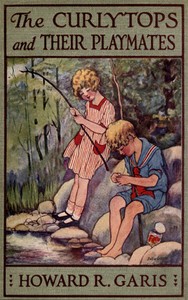
The source record for The Curlytops and Their Playmates; Or, Jolly Times Through the Holidays — A Closer Reading measures this digital text at 49,687 words, 3 hr 37 min estimated reading time, and 6 detected text sections.
The text analysis averages about 12.9 words per sentence, while the detected sections provide another way to judge how the source is divided.
Project Gutenberg metadata also associates the work with “Siblings -- Juvenile fiction,” connecting these edition facts with the source record’s subject description.
Explore this collection
These alternatives are selected using recorded categories and estimated reading time.
About 214 minutes
Fairy Moral Tales
49,026 recorded words. 3 minutes difference from this book's estimate.
View Gutenberg source #24578About 207 minutes
Fairy Moral Tales
47,426 recorded words. 10 minutes difference from this book's estimate.
View Gutenberg source #24410About 199 minutes
Fairy Moral Tales
45,556 recorded words. 18 minutes difference from this book's estimate.
View Gutenberg source #25801Search stored excerpts and compare books → Choose by your preferences →
Choices use stored catalog measurements. Estimates vary with reading speed. A shared category is a catalog label, not a claim that two books have the same argument or literary quality.
Search reads excerpt text stored with this catalog and links to its associated Gutenberg record. The connection is stored in the site database; this tool does not recheck that every excerpt is word-for-word identical to that external record. Excerpt search does not cover every chapter and does not verify historical publication dates.
Catalog snapshot checked: 2026-09-26. Coverage: 93 public books, 93 available source excerpts.
Calculated from edition completeness, EPUB availability, text structure and catalogue metadata. Not a user rating.
Total of 100 points, scaled to a 2.5-5.0 range. Editions with an empty description or a missing EPUB file are not scored.
Public-domain source text
The source text is kept in the dedicated reader, separate from this catalogue record and its commentary.
Howard R. Garis opens 'The Curlytops and Their Playmates' with a scene that immediately establishes the children's perspective: Ted and Janet Martin, nicknamed the Curlytops, are waiting for snow. Their dialogue is marked by repetition and impatience—'When do you s'pose it'll come?' and 'I wish it would hurry'—which captures the singular focus of childhood anticipation. The author builds the world through concrete objects: a toboggan slide made of boards and packing boxes, a cap twist that tangles golden hair, and the gray clouds overhead. These details are not decorative; they are the furniture of the children's reality, and Garis lets them drive the narrative.
Garis's word choices consistently favor immediacy over reflection. Verbs like 'rushed,' 'shouted,' 'laughed,' and 'toddled' keep the action brisk. The children's speech is colloquial and clipped: 'Nope!' as an answer, 'What you looking for?' instead of 'What are you looking for?' This is not an adult narrator describing childhood; it is a narrator who adopts the children's linguistic shortcuts. Even the narrator's own descriptions lean toward the simple: 'a sudden chorus of shouts and laughter' and 'a large puddle of water.' The effect is a prose that moves as quickly as its characters, leaving little room for abstraction.
Each child speaks in a way that reveals age and temperament. Ted, the older boy, uses explanatory phrases: 'It's a good while coming though, isn't it?' Janet mirrors his impatience but with a softer tone: 'Yes, I wish it would hurry.' Trouble, the youngest, speaks in fragments: 'You make big snowman?' and 'I wants get my snowball.' His grammar is consistently nonstandard, marking him as the toddler. Garis does not correct Trouble's speech or have other characters mock it; instead, the narrative accepts it as natural. This fidelity to developmental speech patterns gives the dialogue authenticity and distinguishes each sibling without explicit description.
Snow appears not just as weather but as a narrative engine. The opening chapter revolves entirely around waiting for snow to use the toboggan slide. Later, Trouble hides a snowball under the sink, which melts and causes a puddle—a minor crisis that reveals his logic: 'Maybe I wants make snowman in night.' The snowball is a physical object that carries the child's intention into the adult world, creating a small, comic conflict. Garis uses snow to structure the plot: the trip to Crystal Lake is delayed by rain that melts the snow, then enabled by the promise of more snow at the lake. The element is never merely scenic; it drives action and character decisions.
Garis rarely pauses to describe a character's appearance or feelings directly. Instead, he shows them through action. Ted's 'cap a twist' tangles his hair, which is how we learn it is curly. Janet's concern for Trouble is shown when she 'wanted to laugh, but she did not think it wise.' Uncle Toby's competence is demonstrated by his immediate response to the kitchen leak: 'I can shut off the water in the cellar.' Even the setting is built through what the children do: the toboggan slide is described as they build it, not in a separate paragraph. This technique keeps the narrative anchored in the children's sensory experience and avoids the static quality of authorial summary.
Readers attentive to Garis's craft will notice how he uses small, repeated details—a snowball, a telegram, a runaway dog—to create continuity across chapters. The excerpts show a writer who trusts his young audience to follow cause and effect without heavy explanation. The result is a story that feels driven by its characters' logic, not by adult plotting. For those interested in early twentieth-century children's literature, this book offers a clear example of how an author can build a world entirely from the child's vantage point, using language that never condescends.
There’s a particular quiet in The Curlytops and Their Playmates, the way snow hushes a busy yard, all mischief softened into wonder. I’ve often found that same stillness in Mary Louise Solves a Mystery — Story, Setting & Ideas, where a child’s careful noticing turns a puzzle into something gentle. They are different books, of course, but both understand how keenly a young heart attends to the world’s small clues.
Capture what you thought, learned, and would like to remember.