About 188 minutes
The Auto Boys' Mystery — Reading Companion
Young Readers
43,058 recorded words. 9 minutes difference from this book's estimate.
View Gutenberg source #32742
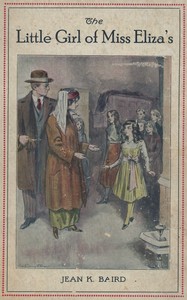
The source record for That Little Girl of Miss Eliza's: A Story for Young People — Background and Themes measures this digital text at 41,054 words, 2 hr 59 min estimated reading time, and 19 detected text sections.
The text analysis averages about 12.3 words per sentence, while the detected sections provide another way to judge how the source is divided.
Project Gutenberg metadata also associates the work with “Conduct of life -- Juvenile fiction,” connecting these edition facts with the source record’s subject description.
Explore this collection
These alternatives are selected using recorded categories and estimated reading time.
About 188 minutes
Young Readers
43,058 recorded words. 9 minutes difference from this book's estimate.
View Gutenberg source #32742About 233 minutes
Young Readers
53,541 recorded words. 54 minutes difference from this book's estimate.
View Gutenberg source #37486About 241 minutes
Young Readers
55,372 recorded words. 62 minutes difference from this book's estimate.
View Gutenberg source #36391Search stored excerpts and compare books → Choose by your preferences →
Choices use stored catalog measurements. Estimates vary with reading speed. A shared category is a catalog label, not a claim that two books have the same argument or literary quality.
Search reads excerpt text stored with this catalog and links to its associated Gutenberg record. The connection is stored in the site database; this tool does not recheck that every excerpt is word-for-word identical to that external record. Excerpt search does not cover every chapter and does not verify historical publication dates.
Catalog snapshot checked: 2026-09-26. Coverage: 93 public books, 93 available source excerpts.
Calculated from edition completeness, EPUB availability, text structure and catalogue metadata. Not a user rating.
Total of 100 points, scaled to a 2.5-5.0 range. Editions with an empty description or a missing EPUB file are not scored.
Public-domain source text
The source text is kept in the dedicated reader, separate from this catalogue record and its commentary.
The novel opens with a landscape so unpromising that even the railroads have 'shot clear of it.' Shintown is described through a series of sharp, almost comic images: houses sagging like 'good intention gone wrong,' gates hanging on one hinge, and fields 'weed-ridden' at the corners. Yet amid this decay stands the old Wells place, painted a peculiar golden brown that marks its occupant as 'just a little different.' This contrast between neglect and distinction sets the stage for Miss Eliza, a woman whose quiet difference is both her burden and her potential.
Baird’s narrative voice moves between dry observation and lyrical description, often within the same paragraph. The opening chapter establishes a world where physical and moral dilapidation are intertwined, and where a single house—and the woman who lives in it—offers a hint of something else.
The narrator’s tone is not uniform. Early descriptions of Shintown are laced with irony: the roads are so bad that ‘Shank’s mare’ is the only reliable transport, and the mountain peaks stand like ‘decorous waiters.’ This wry distance gives way to a more earnest register when the focus turns to Miss Eliza’s inner life. In a conversation with a teacher, she admits she ‘used to think a good deal on that line, but I never could talk of it to any one.’ The teacher’s reply—‘Each one of us must be a Columbus and discover for himself the unfathomed country of his own soul’—is delivered without irony, and Eliza’s response is equally sincere. The shift is abrupt but deliberate, marking moments when the story moves from social observation to personal reflection.
This tonal variation is not a flaw but a structural choice. The ironic passages establish the community’s limitations; the earnest ones show Eliza’s growing awareness of her own. The narrator does not mock her aspirations, even when they are expressed in the elevated language of self-discovery.
The pacing of the prose changes with the scene. In the opening, the description of Shintown is leisurely, piling up details of decay: ‘The chimneys sloped as far as the law of gravity allowed. Gates hung on one hinge, and the fences had the same angle as an old man suffering with lumbago.’ The rhythm is cumulative, almost static, reflecting a place where nothing changes. Later, when Eliza walks home after her conversation with the teacher, the pace quickens: ‘Eliza hurried along with buoyant step. Her feet were light and her hopes high.’ The short sentences and active verbs mirror her sudden energy.
This contrast is reinforced by the dialogue. Doctor Dullmer’s speech is rapid and associative—‘He flitted like a bee from one to another’—while Eliza’s replies are often hesitant or brief. The doctor’s pace contrasts with the slow, deliberate descriptions of the village, suggesting that movement and change are possible only for those who leave Shintown’s physical and mental boundaries.
Certain images recur with enough frequency to become motifs. The color of Miss Eliza’s house—‘golden brown’ that ‘suggested yellow when the sun shone’—is mentioned twice in the opening pages, and the narrator insists that it marks her as ‘just a little different.’ The phrase itself repeats, as if the community cannot quite articulate what sets her apart. Stones and stumps appear in the first paragraph as the ‘best crop’ of Shintown’s fields, and later the soil is said to have ‘as many stones as it had had twenty years before.’ This repetition reinforces the idea of stagnation.
Another recurring detail is the act of looking outward. From the heights of Shintown, characters can see the railroad lines that avoid the village, and later Doctor Dullmer points across the river to a plain where a summer hotel is being built. These glimpses of a world beyond the valley are brief but significant. They remind the reader that Shintown is not isolated by geography alone, but by a collective lack of ambition that the narrative itself observes with a mixture of sympathy and critique.
Readers will notice that Baird’s story does not rush to resolve the mystery of the foundling child. The narrative lingers on the texture of village life and the slow process of Eliza’s self-examination. Pay attention to the moments when the prose shifts from describing what people do to what they think—these are the hinges on which the story turns. The language of self-discovery, when it appears, is earnest but not naive; it is grounded in the same world that produced Shintown’s sagging fences and weed-ridden corners.
Miss Eliza’s quiet reckoning with the foundling reminds me of evenings on my grandmother’s porch, watching her soften toward strays. That Little Girl stirred that same ache. Later, Molly Brown of Kentucky — Story, Setting & Ideas carried a similar warmth—a place shifting slowly, a person learning to hold more than they thought they could. Both felt like old photographs, familiar and faintly aching.
Use these questions to collect your thoughts before moving on.