About 179 minutes
That Little Girl of Miss Eliza's: A Story for Young People — Background and Themes
Young Readers
41,054 recorded words. 102 minutes difference from this book's estimate.
View Gutenberg source #35822
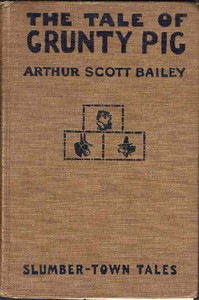
Before opening The Tale of Grunty Pig Slumber-Town Tales — Context and Discussion, the edition data offers a quick orientation: 17,682 words, 1 hr 17 min estimated reading time, and 4 detected text sections.
The text analysis averages about 12.4 words per sentence, while the detected sections provide another way to judge how the source is divided.
Project Gutenberg metadata also associates the work with “Animals -- Juvenile fiction,” connecting these edition facts with the source record’s subject description.
Explore this collection
These alternatives are selected using recorded categories and estimated reading time.
About 179 minutes
Young Readers
41,054 recorded words. 102 minutes difference from this book's estimate.
View Gutenberg source #35822About 188 minutes
Young Readers
43,058 recorded words. 111 minutes difference from this book's estimate.
View Gutenberg source #32742About 233 minutes
Young Readers
53,541 recorded words. 156 minutes difference from this book's estimate.
View Gutenberg source #37486Search stored excerpts and compare books → Choose by your preferences →
Choices use stored catalog measurements. Estimates vary with reading speed. A shared category is a catalog label, not a claim that two books have the same argument or literary quality.
Search reads excerpt text stored with this catalog and links to its associated Gutenberg record. The connection is stored in the site database; this tool does not recheck that every excerpt is word-for-word identical to that external record. Excerpt search does not cover every chapter and does not verify historical publication dates.
Catalog snapshot checked: 2026-09-26. Coverage: 93 public books, 93 available source excerpts.
Calculated from edition completeness, EPUB availability, text structure and catalogue metadata. Not a user rating.
Total of 100 points, scaled to a 2.5-5.0 range. Editions with an empty description or a missing EPUB file are not scored.
Public-domain source text
The source text is kept in the dedicated reader, separate from this catalogue record and its commentary.
The Tale of Grunty Pig opens with a naming scene that establishes the book's playful logic. The smallest of seven piglets is almost called "Runty" until his mother notices his exceptionally loud grunt and adds a G, creating a name that "calls attention to your best point." This moment sets the tone for a story where physical size matters less than character—and where the farmyard residents of Pleasant Valley have plenty to say about both.
Arthur Scott Bailey, author of multiple series including Sleepy-Time Tales and Tuck-Me-In Tales, wrote this 1921 entry in his Slumber-Town series. The excerpts show a world where animals converse freely, worry about Grunty's digging ambitions, and consult experts like Grandfather Mole for advice. The catalog subjects list "Animals," "Conduct of life," and "Swine" as themes, but the actual text focuses more on community problem-solving and gentle humor than on direct moral instruction.
The opening chapter reveals Bailey's method: a simple problem (the runt's name) leads to a character-defining solution. Mrs. Pig decides that "Grunty" highlights her son's best feature—his voice—rather than his small size. This naming strategy recurs throughout the book: characters are often defined by a single trait or role. Jolly Robin is cheerful, Grandfather Mole is the champion digger, and Tommy Fox is tricky. The names function as shorthand for personality, making the large cast easy to follow.
Grunty himself is introduced as almost entirely focused on food, with an appetite that matches his loud grunt. His mother encourages him to eat plenty so he'll grow, but the excerpts suggest that Grunty's growth will be more about experience than size. The catalog subject "Conduct of life" is present only indirectly—through the mother's advice and the community's reactions to Grunty's behavior—rather than through explicit lessons.
One of the most detailed episodes in the excerpts involves Jolly Robin's worry that Grunty Pig will uproot his apple tree. This leads to a consultation with Grandfather Mole, who explains that apple tree roots spread "a good rod in every direction" and that it would take "a hundred Grunty Pigs a whole summer" to dig them free. The humor comes from the contrast between Grunty's boast and the mole's patient, factual assessment.
Bailey uses this scene to showcase his knowledge of farm life and animal behavior. Grandfather Mole's irritation at being interrupted while burrowing, his habit of surfacing in the wrong place, and his precise calculations all add texture. The episode also demonstrates how the community works together—Jolly Robin seeks expert advice rather than panicking, and the mole provides a reassuring answer. This collaborative problem-solving is more prominent in the text than any moral about honesty or hard work.
The excerpts reveal a varied cast with distinct speech patterns. Mrs. Robin is described as "always looking on the dark side of things," and her tart remarks contrast with Jolly Robin's cheerful nature. Grandfather Mole speaks in short, grumpy bursts and is quick to correct misunderstandings. Grunty himself communicates mostly through grunts, though his actions speak loudly.
Bailey's dialogue carries the story forward efficiently. When Jolly Robin asks about digging, Grandfather Mole grumbles, "I thought you said it was about digging," showing his literal-mindedness. The animals' concerns are practical: they worry about trees being uprooted, not about abstract virtues. This focus on concrete problems and their solutions gives the book a grounded feel, even as talking animals roam the farm. The catalog subject "Animals—Juvenile fiction" accurately describes the content, but the animals here are less anthropomorphized than in many children's stories—they retain animal instincts and limitations.
Readers approaching The Tale of Grunty Pig will find a story that rewards attention to small details: the way names reflect character, the precise descriptions of digging and tree roots, and the interplay between worried neighbors and confident experts. The excerpts suggest that Bailey's farm is a place where problems get solved through conversation and common sense, not through dramatic adventures. For those interested in early 20th-century children's literature, this book offers a clear example of the Slumber-Town series' gentle, observational style.
Grunty’s smallness felt like my own childhood certainty that louder meant more, until I learned quiet can hold weight. That caution crept back reading about a boy navigating a swamp’s hidden stillness in Captain Ted: A Boy's Adventures Among Hiding Slackers in the Great Georgia Swamp — Context and Discussion. Both books, in their own way, reminded me that modest footsteps often find what boasting never will.
Answer a few questions and save a private reflection on this device.