About 166 minutes
A Dear Little Girl's Thanksgiving Holidays — A Closer Reading
Childrens Adventures
37,973 recorded words. 5 minutes difference from this book's estimate.
View Gutenberg source #30007
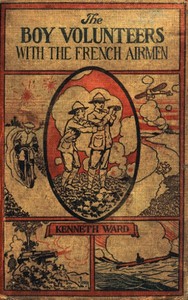
This digital edition of The Boy Volunteers with the French Airmen — Context and Discussion is described by source-level measurements including 39,151 words, 2 hr 51 min estimated reading time, and 4 detected text sections.
The text analysis averages about 16.2 words per sentence, while the detected sections provide another way to judge how the source is divided.
Project Gutenberg metadata also associates the work with “War stories,” connecting these edition facts with the source record’s subject description.
Explore this collection
These alternatives are selected using recorded categories and estimated reading time.
About 166 minutes
Childrens Adventures
37,973 recorded words. 5 minutes difference from this book's estimate.
View Gutenberg source #30007About 176 minutes
Childrens Adventures
40,385 recorded words. 5 minutes difference from this book's estimate.
View Gutenberg source #33383About 176 minutes
Childrens Adventures
40,341 recorded words. 5 minutes difference from this book's estimate.
View Gutenberg source #35199Search stored excerpts and compare books → Choose by your preferences →
Choices use stored catalog measurements. Estimates vary with reading speed. A shared category is a catalog label, not a claim that two books have the same argument or literary quality.
Search reads excerpt text stored with this catalog and links to its associated Gutenberg record. The connection is stored in the site database; this tool does not recheck that every excerpt is word-for-word identical to that external record. Excerpt search does not cover every chapter and does not verify historical publication dates.
Catalog snapshot checked: 2026-09-26. Coverage: 93 public books, 93 available source excerpts.
Calculated from edition completeness, EPUB availability, text structure and catalogue metadata. Not a user rating.
Total of 100 points, scaled to a 2.5-5.0 range. Editions with an empty description or a missing EPUB file are not scored.
Public-domain source text
The source text is kept in the dedicated reader, separate from this catalogue record and its commentary.
The excerpt from Kenneth Ward's 1917 novel drops readers into a specific, disorienting aerial experience: a pilot trapped inside a thundercloud, with lightning appearing as "balls of fire" rather than streaks, a compass needle spinning so fast it cannot be read, and a "pungent" odor that proves "decidedly exhilarating." This is not a generic war story; the passage dwells on the sensory and technical confusion of flight—the pilot cannot tell direction, altitude, or whether the machine is moving with or against the storm. The boys, Ralph and Alfred, listen as the pilot recounts the episode, their questions pressing for concrete details: how high, how long, could you see the earth?
The storm sequence in the excerpt is built around a series of failed instruments and unreliable perceptions. The compass needle "swung around with such velocity" that it could not be seen; the pilot could not determine whether the aircraft was moving with the storm or against it. He notes that the lightning lacked the familiar zig-zag shape seen from the ground, appearing instead as "balls of fire" that burst with a crackling sound. The altitude reading—770 meters—is given only after descent, and even then the rain is so heavy that the earth remains invisible. The pilot’s account is structured as a puzzle: each attempt to regain orientation (turning, descending, ascending) only deepens the uncertainty.
Ralph and Alfred function primarily as listeners in this excerpt, their questions shaping the pilot’s narrative. Alfred asks, "What were you thinking about while all this was happening?"—a prompt that draws out the pilot’s subjective experience of fascination rather than fear. Ralph’s queries are more technical: "How high were you up?" and "Couldn't you tell which way the wind was blowing?" Their presence frames the storm story as an oral report, with the pilot repeatedly answering with precise measurements ("seven hundred and seventy meters") or admissions of ignorance ("we could not possibly say whether we were going north or south"). This dynamic positions the boys as stand-ins for the reader, absorbing a lesson in the limits of aerial navigation.
The pilot repeatedly contrasts his airborne perspective with ordinary ground-level experience. Lightning, he explains, does not appear in "streaks, darting hither and thither" but as momentary spheres of flame. The thunder is "weird beyond description," and the storm’s odor—likely ozone or nitrous compounds—is "not at all unpleasant, but decidedly exhilarating." He notes that the machine sailed "smoothly" despite the violence around it, and that he felt "no particular sense of danger" after the first moments. These observations create a consistent pattern: the air warps familiar phenomena, turning danger into fascination and disorientation into a kind of calm. The pilot’s tone is analytical, almost clinical, even as he describes being carried into enemy territory without knowing it.
The excerpt is almost entirely dialogue, with the pilot’s long speech punctuated by the boys’ short questions. This structure gives the passage the feel of an interview or debriefing. The pilot’s account is linear but full of backtracking and qualification: he tried an experiment, feared to descend, noted the time, then realized they were moving with the storm. The boys’ interjections—"How long were you in the storm?"—keep the narrative anchored in measurable facts. The result is a hybrid of adventure story and technical report, where the thrill comes not from action but from the precise description of a bewildering experience.
The excerpt offers a concentrated sample of the novel’s method: placing young American protagonists in situations where they must absorb expert testimony about the new technology of flight. Readers should attend to how the pilot’s language mixes measurement with wonder, and how the boys’ questions guide the flow of information. The storm scene is less about combat than about the strange, isolating physics of early aviation—a theme that may recur throughout the book.
I keep thinking about that storm in The Boy Volunteers with the French Airmen—how the compass spun and the air smelled strange, like something just beyond understanding. It reminded me of another kind of disorientation, quieter but just as real, in Samba: A Story of the Rubber Slaves of the Congo — Reading Companion. Both felt like being lost inside someone else's weather.
A brief reflection can help important ideas stay with you longer.