About 224 minutes
Boy Scouts in the North Sea; Or, The Mystery of a Sub — Reading Companion
School Stories
51,355 recorded words. 8 minutes difference from this book's estimate.
View Gutenberg source #25798
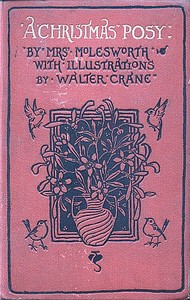
For A Christmas Posy — Edition Insights, the stored edition analysis reports 49,669 words, 3 hr 36 min estimated reading time, and 6 detected text sections.
The text analysis averages about 17.6 words per sentence, while the detected sections provide another way to judge how the source is divided.
Project Gutenberg metadata also associates the work with “Conduct of life -- Juvenile fiction,” connecting these edition facts with the source record’s subject description.
Explore this collection
These alternatives are selected using recorded categories and estimated reading time.
About 224 minutes
School Stories
51,355 recorded words. 8 minutes difference from this book's estimate.
View Gutenberg source #25798About 201 minutes
School Stories
46,157 recorded words. 15 minutes difference from this book's estimate.
View Gutenberg source #37291About 236 minutes
School Stories
54,153 recorded words. 20 minutes difference from this book's estimate.
View Gutenberg source #39799Search stored excerpts and compare books → Choose by your preferences →
Choices use stored catalog measurements. Estimates vary with reading speed. A shared category is a catalog label, not a claim that two books have the same argument or literary quality.
Search reads excerpt text stored with this catalog and links to its associated Gutenberg record. The connection is stored in the site database; this tool does not recheck that every excerpt is word-for-word identical to that external record. Excerpt search does not cover every chapter and does not verify historical publication dates.
Catalog snapshot checked: 2026-09-26. Coverage: 93 public books, 93 available source excerpts.
Calculated from edition completeness, EPUB availability, text structure and catalogue metadata. Not a user rating.
Total of 100 points, scaled to a 2.5-5.0 range. Editions with an empty description or a missing EPUB file are not scored.
Public-domain source text
The source text is kept in the dedicated reader, separate from this catalogue record and its commentary.
The collection begins not with a Christmas scene but with a quiet farewell in a Paris salon on New Year's Eve. Sylvia and Molly watch their aunt leave, and the narrator notes that Sylvia is 'remembering how different it was this day last year.' The story, titled 'Grandmother Dear's Old Watch,' immediately establishes a tone of gentle melancholy and family bonds. The sisters' dialogue—'Couldn't you wait till the day after to-morrow?'—reveals their reluctance to be left alone, while the aunt's private thoughts about 'poor Sylvia' and 'dear Molly's good spirits' set up a pattern of caring adults and vulnerable children.
The first story opens with specific, concrete details: the 'lace-shrouded windows' of a Paris apartment, the 'handsome marble stairs,' and the date—December 31st. The sisters Sylvia and Molly are not generic Victorian children; Sylvia is described as sad, Molly as spirited. The aunt's internal monologue—'I cannot make up to you for grandmother'—hints at a recent loss without explaining it. This restraint is typical of Molesworth's approach: she trusts readers to infer grief from behavior. The excerpt also shows the sisters watching their aunt from a 'tiny balcony,' a small but vivid detail that grounds the scene in a real, observed space.
In 'Basil's Violin,' the narrative shifts to a boy's moral dilemma. Basil's teacher, Herr Wildermann, admits he is poor: 'We are very poor. And also I had hoped much from giving you lessons.' The exchange is remarkable for its directness about money—a subject often softened in children's literature. Basil, initially slow to understand, eventually says, 'I did not understand before. If I had known—but even now it is not too late.' The story does not resolve the problem quickly; instead, it shows Basil negotiating a compromise of six more lessons. The teacher's pride—'It would be a mere charity to me'—adds complexity, and Basil's internal resolve ('I believe I could have got on if I had really tried') suggests a coming-of-age moment.
Across the excerpts, certain patterns emerge. The opening story involves a missing watch (the 'old watch' of the title), while 'Basil's Violin' centers on the threat of losing lessons. Both hinge on objects that carry emotional or financial weight. The Christmas setting is understated: the first story takes place on New Year's Eve, and the collection's title promises a 'posy' of holiday tales, but the excerpts focus more on everyday trials—sadness, poverty, the need to make amends. The illustrations by Walter Crane, listed in the contents, suggest visual emphasis on key moments: a sister at a balcony, a boy with a violin, a dog wagging its tail. These images likely reinforce the stories' domestic, sentimental tone.
Mrs. Molesworth's prose is notable for its plainness and emotional control. She avoids melodrama even in tense scenes: when Basil's teacher says, 'It is all settled,' the sentence is flat, resigned. The narrator rarely intrudes with moralizing; instead, lessons emerge from characters' choices. In the first story, the aunt's tears are mentioned but not dwelled upon. The dialogue carries the weight—Sylvia's sigh, Molly's eagerness, Basil's hesitant questions. This restraint may make the stories feel understated to modern readers accustomed to more explicit sentiment, but it also gives the characters room to act with dignity. The collection, published in 1888, reflects a late-Victorian interest in children's inner lives and ethical growth.
As you read A Christmas Posy, pay attention to how Molesworth uses small, tangible objects—a watch, a violin, a missing bonbon—to anchor larger emotional conflicts. The stories reward careful attention to dialogue and gesture; characters often reveal more through what they leave unsaid. The collection is best approached as a series of quiet, character-driven vignettes rather than a single narrative arc. Let the illustrations by Walter Crane guide your eye to the moments the author considered pivotal.
Reading Mrs. Molesworth's gentle tales, I was struck by how quietly her children learn to tell the truth, almost by accident. It reminded me of another small world where honesty is woven into daily rhythm rather than declared. The same warmth flickers through. The Tale of Rusty Wren — Reading Companion holds that similar, unhurried hush, as if winter light were falling across a windowsill where a watch or a feather simply waits to be found.
Use these questions to collect your thoughts before moving on.