About 239 minutes
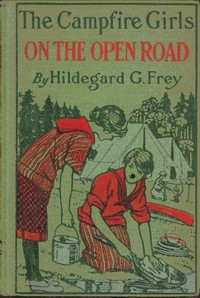
The Camp Fire Girls on the Open Road; Or, Glorify Work — Edition Insights
School Stories
54,857 recorded words. 1 minutes difference from this book's estimate.
View Gutenberg source #36485
Before opening Rocky Mountain Boys; Or, Camping in the Big Game Country — Text and Context, the edition data offers a quick orientation: 55,188 words, 4 hr estimated reading time, and 6 detected text sections.
The text analysis averages about 26.9 words per sentence, while the detected sections provide another way to judge how the source is divided.
Project Gutenberg metadata also associates the work with “Camping -- Juvenile fiction,” connecting these edition facts with the source record’s subject description.
Explore this collection
These alternatives are selected using recorded categories and estimated reading time.
About 239 minutes
School Stories
54,857 recorded words. 1 minutes difference from this book's estimate.
View Gutenberg source #36485About 236 minutes
School Stories
54,153 recorded words. 4 minutes difference from this book's estimate.
View Gutenberg source #39799About 224 minutes
School Stories
51,355 recorded words. 16 minutes difference from this book's estimate.
View Gutenberg source #25798Search stored excerpts and compare books → Choose by your preferences →
Choices use stored catalog measurements. Estimates vary with reading speed. A shared category is a catalog label, not a claim that two books have the same argument or literary quality.
Search reads excerpt text stored with this catalog and links to its associated Gutenberg record. The connection is stored in the site database; this tool does not recheck that every excerpt is word-for-word identical to that external record. Excerpt search does not cover every chapter and does not verify historical publication dates.
Catalog snapshot checked: 2026-09-26. Coverage: 93 public books, 93 available source excerpts.
Calculated from edition completeness, EPUB availability, text structure and catalogue metadata. Not a user rating.
Total of 100 points, scaled to a 2.5-5.0 range. Editions with an empty description or a missing EPUB file are not scored.
Public-domain source text
The source text is kept in the dedicated reader, separate from this catalogue record and its commentary.
St. George Rathborne opens Rocky Mountain Boys with two companions, Tom Tucker and Felix Edmondson, trudging under heavy packs toward a dugout cabin in the Wyoming Rockies. The first chapter establishes a quiet tension between the pair: Tom is stocky, sun-bronzed, and woods-wise; Felix is tall, city-bred, and recovering his health. Their dialogue reveals they have been three days on the trail since a boatman named Frazer dropped them off. The boys carry repeating rifles, hunting knives, and snow-shoes strapped to their packs—a detail that signals the author’s attention to practical gear. Felix, who hopes to become a surgeon, calls the surrounding forest the “primeval wilderness” in a humorous tone that hints at his self-awareness. The narrative voice stays close to the boys’ immediate perceptions, mixing dialogue with brisk description of the landscape.
The excerpts repeatedly draw a line between Felix’s theoretical knowledge and Tom’s practiced skill. When Felix gets lost in a snowstorm, he admits that “his knowledge of woodcraft seemed at fault” and that he “could not give the slightest guess” about direction. A woodsman, the narrator notes, would have known how to tell time without moon or stars. Felix’s predicament is not just physical—he is hungry, cold, and disoriented—but also intellectual: he has read about survival but cannot apply it. Tom, by contrast, is introduced as the one who interprets the chart given by “old Sol Ten Eyck.” The story does not present Felix’s weakness as a flaw to be mocked; rather, it treats his struggle as a genuine test. The author uses Felix’s internal monologue to show him reasoning through his situation, even when his reasoning fails. This pattern of contrasting book-learning with lived experience runs through the chapters and gives the adventure a quiet educational dimension.
When Felix becomes separated from Tom, the narrative shifts into a sustained survival sequence. He builds a shelter he names “Camp Shiver,” a boyish label that undercuts the seriousness of his situation. The storm leaves about three inches of snow, and Felix waits through the night, checking the sky repeatedly for signs of dawn. The author tracks time by Felix’s own count—“the seventh time” he crawled out—rather than by an omniscient clock. Hunger becomes a vivid presence: Felix has “visions of all the glorious dishes he and Tom had ever eaten.” The prose stays close to his senses: the smell of smoke, the sight of a peculiar peak, the bark of mongrel curs. The peak is the same one Charley Crow had pointed to earlier, a detail that rewards attentive reading. Felix’s relief upon finding the Indian cabin is palpable, but the text does not resolve his larger predicament—he still needs to rejoin Tom. The episode demonstrates that the author is willing to let his protagonist fail, struggle, and rely on luck as much as skill.
Rathborne gives each character a distinct speech pattern. Tom uses contractions and colloquialisms: “I reckon we’ll sight the dugout inside of half an hour or so.” Felix’s speech is more formal, even when he is trying to be casual: “We must be pretty nearly there now, Tom, I take it.” The narrator occasionally adopts a folksy tone, referring to the Rockies as the “back-bone of the continent” and calling Felix “the Little Doctor” through Charley Crow. The dialogue is functional—it conveys information about distance, gear, and plans—but it also reveals character. When Felix shouts for help in the snow forest, he stops because it seems “next to foolish.” The author does not over-explain; he lets the action speak. The exchanges between the boys and the rough men they encounter are clipped and wary, suggesting a social hierarchy in which the boys are outsiders. The vernacular is consistent without becoming caricature, grounding the adventure in a specific time and place.
Readers will find that the book’s pleasures lie less in plot twists than in the accumulation of small, credible details: the weight of a pack after three days, the taste of venison after a long hunt, the relief of smoke on a cold wind. The author trusts his audience to notice the difference between Tom’s competence and Felix’s learning curve. Pay attention to the way characters name things—Camp Shiver, the Little Doctor, the primeval wilderness—because those names carry the story’s quiet humor and its respect for the boys’ resourcefulness.
Rathborne's boys, shivering in that dugout cabin, made me recall how the same wilderness wonder—that mix of terror and awe—settles quietly into young readers decades apart. My old copy of Rocky Mountain Boys felt echoed while leafing through Two little travellers — Edition Insights, another glimpse of childhood adventure carried in careful prose, each footprint faint but still visible.
Create a short personal record of your experience with this book.