About 262 minutes
Two little travellers — Edition Insights
School Stories
60,216 recorded words. 9 minutes difference from this book's estimate.
View Gutenberg source #25972
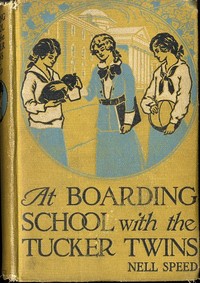
The catalog record for At Boarding School with the Tucker Twins — Inside the Classic provides practical reading context through 62,316 words, 4 hr 31 min estimated reading time, and 8 detected text sections.
The text analysis averages about 17.4 words per sentence, while the detected sections provide another way to judge how the source is divided.
Project Gutenberg metadata also associates the work with “Twins -- Juvenile fiction,” connecting these edition facts with the source record’s subject description.
Explore this collection
These alternatives are selected using recorded categories and estimated reading time.
About 262 minutes
School Stories
60,216 recorded words. 9 minutes difference from this book's estimate.
View Gutenberg source #25972About 240 minutes
School Stories
55,188 recorded words. 31 minutes difference from this book's estimate.
View Gutenberg source #37803About 239 minutes
School Stories
54,857 recorded words. 32 minutes difference from this book's estimate.
View Gutenberg source #36485Search stored excerpts and compare books → Choose by your preferences →
Choices use stored catalog measurements. Estimates vary with reading speed. A shared category is a catalog label, not a claim that two books have the same argument or literary quality.
Search reads excerpt text stored with this catalog and links to its associated Gutenberg record. The connection is stored in the site database; this tool does not recheck that every excerpt is word-for-word identical to that external record. Excerpt search does not cover every chapter and does not verify historical publication dates.
Catalog snapshot checked: 2026-09-26. Coverage: 93 public books, 93 available source excerpts.
Calculated from edition completeness, EPUB availability, text structure and catalogue metadata. Not a user rating.
Total of 100 points, scaled to a 2.5-5.0 range. Editions with an empty description or a missing EPUB file are not scored.
Public-domain source text
The source text is kept in the dedicated reader, separate from this catalogue record and its commentary.
The novel opens with Page Allison leaving home on a damp, cold morning before dawn, a departure she considers "about the worst thing that could befall a girl of fifteen." This immediate focus on the emotional weight of a common experience—leaving home—sets the tone for a story that treats adolescent feelings with seriousness. The first chapter establishes Page's relationship with Mammy Susan, an enslaved servant who speaks in dialect and has cared for her since birth, and introduces the cold-bath ritual Page inherited from her English grandfather. These early details ground the narrative in specific domestic practices and hint at the social hierarchies that will shape the boarding school world.
The story is told in first person by Page Allison, whose voice carries a mix of self-deprecation and earnestness. She notes that "whatever age you happen to be seems to be the age in which hardships are the most difficult to bear," a reflection that suggests a budding self-awareness. Her narration often includes direct dialogue with Mammy Susan, whose dialect contrasts with Page's standard English, marking differences in education and social standing. Page also uses colloquial expressions like "Well, what ho!" when the Tucker twins burst into her room, and she references the Tar Baby from Uncle Remus stories to describe her own silence. These choices root the voice in early twentieth-century American culture and indicate a narrator who is observant but not overly analytical.
The excerpts show that friendships at Gresham involve both loyalty and concealment. Page becomes the confidante of Annie Pore, a girl other students call "Orphan Annie." Annie reveals that her mother has sent her money for clothes, but she is afraid to tell her father. Page advises her to be "perfectly frank" and to write to him immediately, yet she also tells Annie to send the clothing order first before "the Governor has time to veto it." This advice reveals a pragmatic moral code: honesty is important, but so is timing. The Tucker twins, Dum and Dee, are curious about Annie's secrets, but Page refuses to share them, even when Dee correctly guesses that Annie has confided in her. The dynamic among the girls involves teasing, loyalty, and the careful management of information.
The concert in Chapter XIII provides a stage for displaying social status. Mabel Binks, whose "flashy selection on the piano" and "le dernier cri of fashion" mark her as a show-off, contrasts with Annie Pore, who looks beautiful in a dress bought with her mother's secret money. Page lends Annie her white slippers, a small act that reinforces their bond and helps Annie perform respectability. Miss Jane Cox, the music teacher, worries about pupils who "will sing flat" and hopes Annie will "save the day." The concert thus becomes a moment where hidden resources—money, talent, friendship—are publicly tested. The presence of townspeople and boys from Hill-Top School underscores the semi-public nature of boarding school life, where personal conduct reflects on family and institution alike.
Readers should note that the excerpts cover only the first third of the novel and focus on establishing character and setting. The catalog subjects—twins, friendship, boarding schools, and student social life—are all present, but the story also engages with class, secrecy, and the tension between parental authority and adolescent independence. Pay attention to how Page's narration balances her own growth with the unfolding stories of her friends, and consider how the novel uses minor characters like Mammy Susan and Mabel Binks to comment on the social order of the school.
It’s funny how a school story can stay with you—that quiet ache of being new, of watching others belong first. Page Allison’s careful friendships in the Tucker twins book reminded me of something gentler I found later, in The Camp Fire Girls on the Open Road; Or, Glorify Work — Edition Insights. Same softness around daily effort, same unspoken class lines. I thought of both this morning, oddly, while folding laundry.
Create a short personal record of your experience with this book.