About 191 minutes
The Girls of Central High on the Stage; Or, The Play That Took The Prize — Edition Insights
School Stories
43,832 recorded words. 112 minutes difference from this book's estimate.
View Gutenberg source #37303
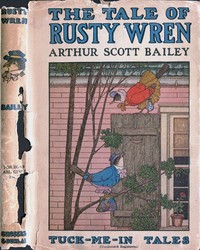
This digital edition of The Tale of Rusty Wren — Reading Companion is described by source-level measurements including 18,034 words, 1 hr 19 min estimated reading time, and 3 detected text sections.
The text analysis averages about 14.3 words per sentence, while the detected sections provide another way to judge how the source is divided.
Project Gutenberg metadata also associates the work with “Animals -- Juvenile fiction,” connecting these edition facts with the source record’s subject description.
Explore this collection
These alternatives are selected using recorded categories and estimated reading time.
About 191 minutes
School Stories
43,832 recorded words. 112 minutes difference from this book's estimate.
View Gutenberg source #37303About 201 minutes
School Stories
46,157 recorded words. 122 minutes difference from this book's estimate.
View Gutenberg source #37291About 216 minutes
School Stories
49,669 recorded words. 137 minutes difference from this book's estimate.
View Gutenberg source #26015Search stored excerpts and compare books → Choose by your preferences →
Choices use stored catalog measurements. Estimates vary with reading speed. A shared category is a catalog label, not a claim that two books have the same argument or literary quality.
Search reads excerpt text stored with this catalog and links to its associated Gutenberg record. The connection is stored in the site database; this tool does not recheck that every excerpt is word-for-word identical to that external record. Excerpt search does not cover every chapter and does not verify historical publication dates.
Catalog snapshot checked: 2026-09-26. Coverage: 93 public books, 93 available source excerpts.
Calculated from edition completeness, EPUB availability, text structure and catalogue metadata. Not a user rating.
Total of 100 points, scaled to a 2.5-5.0 range. Editions with an empty description or a missing EPUB file are not scored.
Public-domain source text
The source text is kept in the dedicated reader, separate from this catalogue record and its commentary.
The narrative voice in The Tale of Rusty Wren moves briskly through domestic negotiations and sudden crises. Early on, Rusty and his wife debate nesting sites with clipped, decisive dialogue—Rusty's "That won't do" and his wife's insistence on living near the farmhouse establish a pattern of marital negotiation that recurs throughout. The pace accelerates markedly when Rusty posts a "Boy Wanted" sign outside his home, drawing a series of unsuitable applicants. The story's rhythm shifts from calm description to urgent, almost farcical encounters, as when Fatty Coon and Tommy Fox arrive at midnight to find the sign already taken down.
Bailey uses dialogue to control tempo. In the opening chapter, Rusty and his wife trade short, pointed lines that quickly resolve the nesting dispute: she wants a farmhouse location; he vetoes the shutter idea with a practical objection about falling eggs. The back-and-forth is rapid, with minimal narration between speeches. Later, when Rusty interviews Chippy, Jr., the exchange is polite and measured—"Good-evening!" and "I see you want a boy"—slowing the pace to a courteous crawl. But when an English sparrow jeers at Rusty, the dialogue turns sharp: "I'm very glad I'm not going to work for you," followed by a "jeering laugh." These tonal shifts in conversation mark changes in narrative speed, from domestic calm to social tension.
Rusty Wren's voice is partly built from repeated phrases and characteristic responses. He shakes his head "quickly—and with decision" when rejecting the shutter idea, a mannerism that signals his firmness. His wife, Mrs. Rusty, often has the last word: she "made the matter so plain that Rusty knew there was no use of trying to change her mind." The narrator also uses formulaic tags like "said Rusty Wren" and "observed" to maintain a consistent storytelling rhythm. The sign "Boy Wanted" becomes a recurring verbal motif, appearing in chapter titles and dialogue alike, anchoring the middle section's comic urgency. These repetitions give the prose a patterned, oral quality suited to the Tuck-Me-In Tales series.
The book's three-part structure—home selection, domestic crisis, and hiring a helper—creates a clear arc of accelerating pace. The first chapters move slowly, with Rusty and his wife inspecting potential nests and debating location. The middle chapters introduce the alarm clock incident and Rusty's jealousy, quickening the tempo through a series of small conflicts. The pace peaks when Rusty posts the "Boy Wanted" sign: a parade of callers arrives, each encounter briefer and more absurd than the last. The midnight visit by Fatty Coon and Tommy Fox, who find no sign, is a comic crescendo. After Chippy, Jr. is hired, the pace relaxes into steady domestic routine, signaled by Rusty sleeping "more soundly" than he had in days.
Readers attentive to voice will notice how Bailey varies sentence length to mirror emotional states: short, clipped lines during arguments, longer descriptive passages when Rusty is content. The frequent use of dashes and exclamation marks in dialogue heightens the sense of immediacy. Pay particular attention to the way Mrs. Rusty's warnings—"this is going to lead to trouble"—foreshadow later accidents, a subtle narrative device that rewards careful reading.
That rainy afternoon, Rusty Wren’s desperate search for a nest made me think about how we all just improvise our homes. When the rain finally let up, I found myself reaching for The Camp Fire Girls on the Open Road; Or, Glorify Work — Edition Insights, and it felt like the same story, told differently—learning to make do with what the road hands you.
Create a short personal record of your experience with this book.