About 216 minutes
A Christmas Posy — Edition Insights
School Stories
49,669 recorded words. 8 minutes difference from this book's estimate.
View Gutenberg source #26015

The catalog record for Boy Scouts in the North Sea; Or, The Mystery of a Sub — Reading Companion provides practical reading context through 51,355 words, 3 hr 44 min estimated reading time, and 7 detected text sections.
The text analysis averages about 11.0 words per sentence, while the detected sections provide another way to judge how the source is divided.
Project Gutenberg metadata also associates the work with “Submarines (Ships) -- Juvenile fiction,” connecting these edition facts with the source record’s subject description.
Explore this collection
These alternatives are selected using recorded categories and estimated reading time.
About 216 minutes
School Stories
49,669 recorded words. 8 minutes difference from this book's estimate.
View Gutenberg source #26015About 236 minutes
School Stories
54,153 recorded words. 12 minutes difference from this book's estimate.
View Gutenberg source #39799About 239 minutes
School Stories
54,857 recorded words. 15 minutes difference from this book's estimate.
View Gutenberg source #36485Search stored excerpts and compare books → Choose by your preferences →
Choices use stored catalog measurements. Estimates vary with reading speed. A shared category is a catalog label, not a claim that two books have the same argument or literary quality.
Search reads excerpt text stored with this catalog and links to its associated Gutenberg record. The connection is stored in the site database; this tool does not recheck that every excerpt is word-for-word identical to that external record. Excerpt search does not cover every chapter and does not verify historical publication dates.
Catalog snapshot checked: 2026-09-26. Coverage: 93 public books, 93 available source excerpts.
Calculated from edition completeness, EPUB availability, text structure and catalogue metadata. Not a user rating.
Total of 100 points, scaled to a 2.5-5.0 range. Editions with an empty description or a missing EPUB file are not scored.
Public-domain source text
The source text is kept in the dedicated reader, separate from this catalogue record and its commentary.
The novel opens with four Boy Scouts in a railway carriage crossing a flooded landscape, their dialogue immediately establishing both setting and tone. Jimmie’s exclamation, “This train’s running on a regular lake!” and the reference to Belgians cutting dikes to drive out Germans ground the story in World War I realities. The narrator then directly addresses readers familiar with earlier volumes, while newcomers receive a brief summary of the boys’ recent manhunt through France and Belgium. This dual approach—specific incident plus series context—shapes expectations for an adventure that blends historical conflict with scout resourcefulness.
The opening chapter relies heavily on spoken exchange to convey information. The boys’ banter about the flooded countryside and their destination in Holland reveals their situation without lengthy exposition. When Jimmie jokes about his “dream book,” the others laugh, signaling a camaraderie that persists throughout the excerpts. Later, in the submarine, the boys use “mute language” (sign language) to communicate under the noses of German officers. This shift from spoken to silent dialogue underscores their adaptability and the constant threat of discovery. The contrast between casual talk and coded signals gives the reader a clear sense of the stakes: what can be said aloud is safe; what must be signed is dangerous.
The middle excerpts center on the boys’ inspection of a nearly complete submarine, which Ned notes “looks a lot like the ‘U-13’.” The inventory they take—food stores, engines, pumps, electrical systems—reads like a checklist of readiness. Jimmie’s hope that “the storm increases” hints at a plan to use weather as cover. The orderly’s arrival and the sudden appearance of Mackinder (a figure from earlier in the series) introduce a new layer of mystery. The text does not explain Mackinder’s presence or his role, leaving the reader to piece together clues alongside the scouts. This section rewards attention to detail: every piece of equipment and every glance exchanged may prove significant.
Throughout the excerpts, the boys’ use of sign language becomes a narrative device for building tension. In the general’s office, they “communicate with each other by means of the mute language” to suppress excitement. Later, inside the submarine, they continue signing “for the sake of absolute safety.” This technique allows the author to show the boys’ coordination and intelligence while keeping their plans hidden from both German characters and the reader. The effect is twofold: it creates a sense of shared secrecy among the scouts, and it invites the reader to infer what is being communicated. The climax of this silent thread comes when Jimmie spots Mackinder at the hatch—a moment that breaks the code and signals a shift from covert inspection to direct confrontation.
The narrative explicitly acknowledges its place in a series. The opening paragraph states that “to those of our readers who have followed the adventures of this group of boys… no introduction is necessary,” while offering a brief recap for newcomers. This dual address shapes the reading experience: returning readers will recognize Ned Nestor as “Leader of the Wolf Patrol” and anticipate recurring characters like Mackinder; new readers are given just enough context to follow the plot without feeling lost. The excerpts do not resolve the mystery of the U-13 or Mackinder’s reappearance, leaving both groups with unanswered questions. The story thus functions as both a standalone episode and a continuation, rewarding familiarity but not requiring it.
The North Sea setting and references to World War I—flooded Belgian fields, German lines, neutral Holland—place the adventure in a specific historical moment. The boys move between French and German trenches and now find themselves in a German-held harbor. The submarine they inspect is being readied for a cruise, and the urgency of the work is emphasized by Gruenwold’s “smile” at the need for completion. These details ground the boys’ exploits in real wartime logistics, even as the story leans into serialized adventure. The reader is encouraged to note how historical facts (dikes, submarines, blockades) are woven into the plot without becoming the main focus.
As you read, pay attention to what the boys say aloud versus what they signal silently—the gap between spoken and signed dialogue often marks the difference between safety and risk. The recurring mention of the U-13, both as a sunken vessel and as a model for the new submarine, suggests a mystery that may connect past and present events. The excerpts offer no resolution, so treat each clue as a piece of a larger puzzle that the scouts are still assembling.
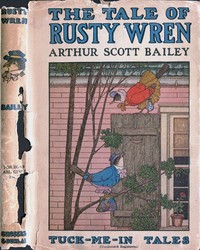
There's something about how the U-13's mystery lingers through the dialogue that feels familiar, a slow unfolding rather than a reveal. It reminds me of another quiet patience found in The Tale of Rusty Wren — Reading Companion, where every chirp is a clue, and the whole story waits, unhurried, like an afternoon I once sat out on a porch listening.
Create a short personal record of your experience with this book.